
Last updated September 20, 2026
Free on-site gate assessment - hinges, posts, and your LiftMaster or Nice gate operator checked before anything is quoted
The assessment is free and the quote is the invoice.

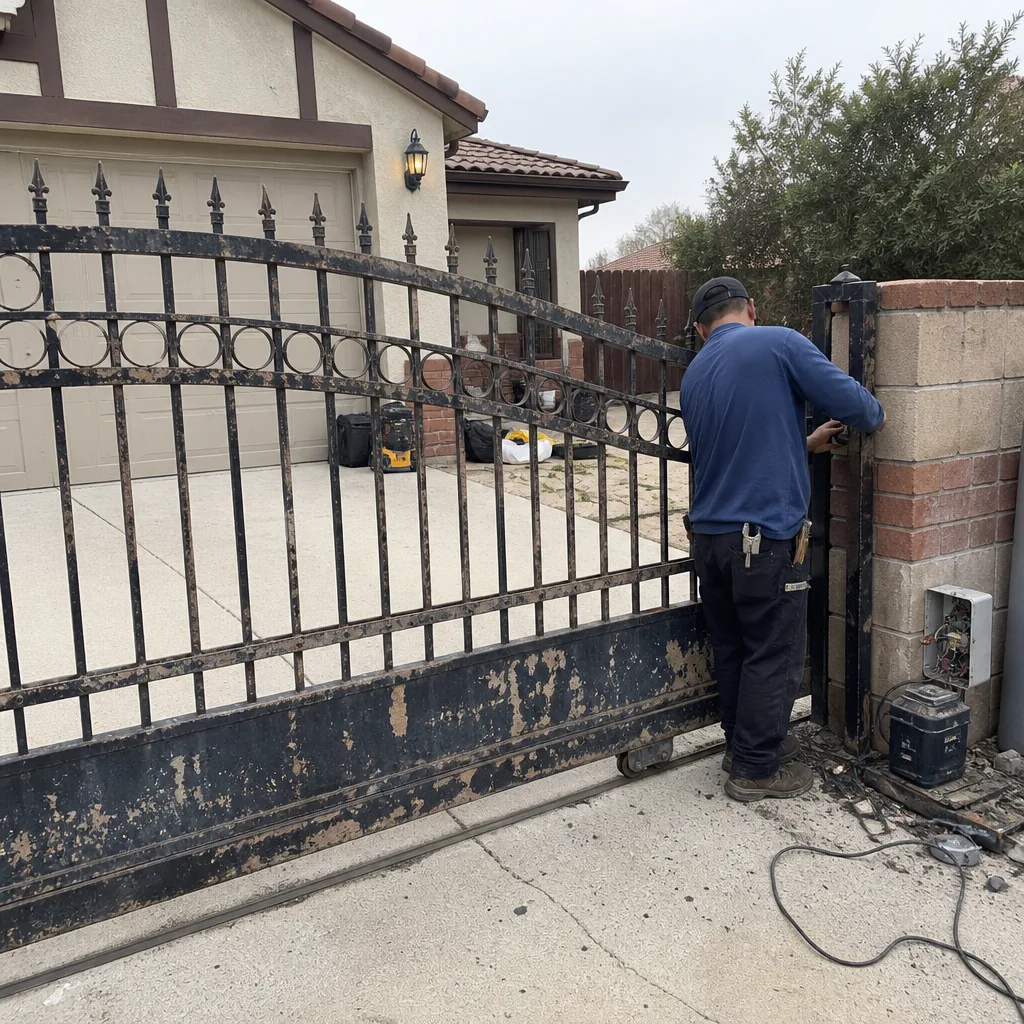 Before
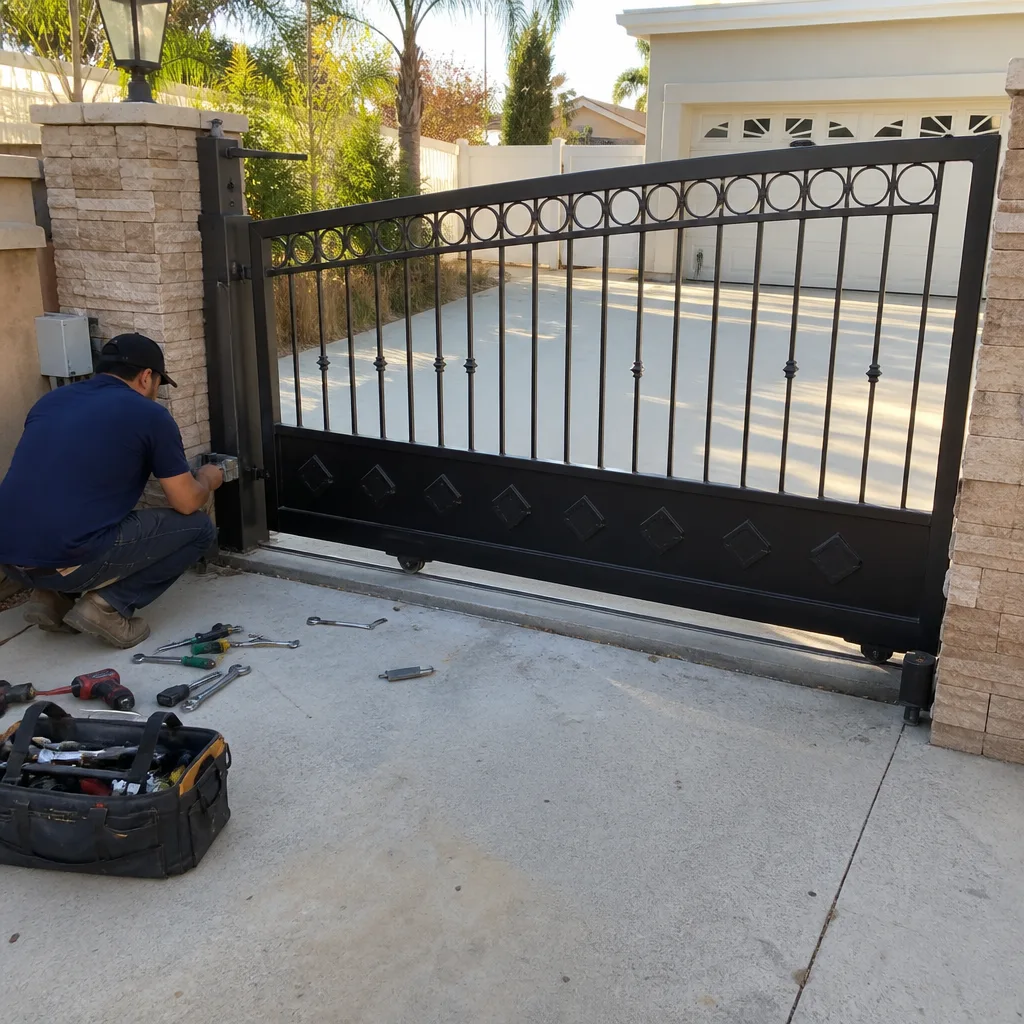 After
After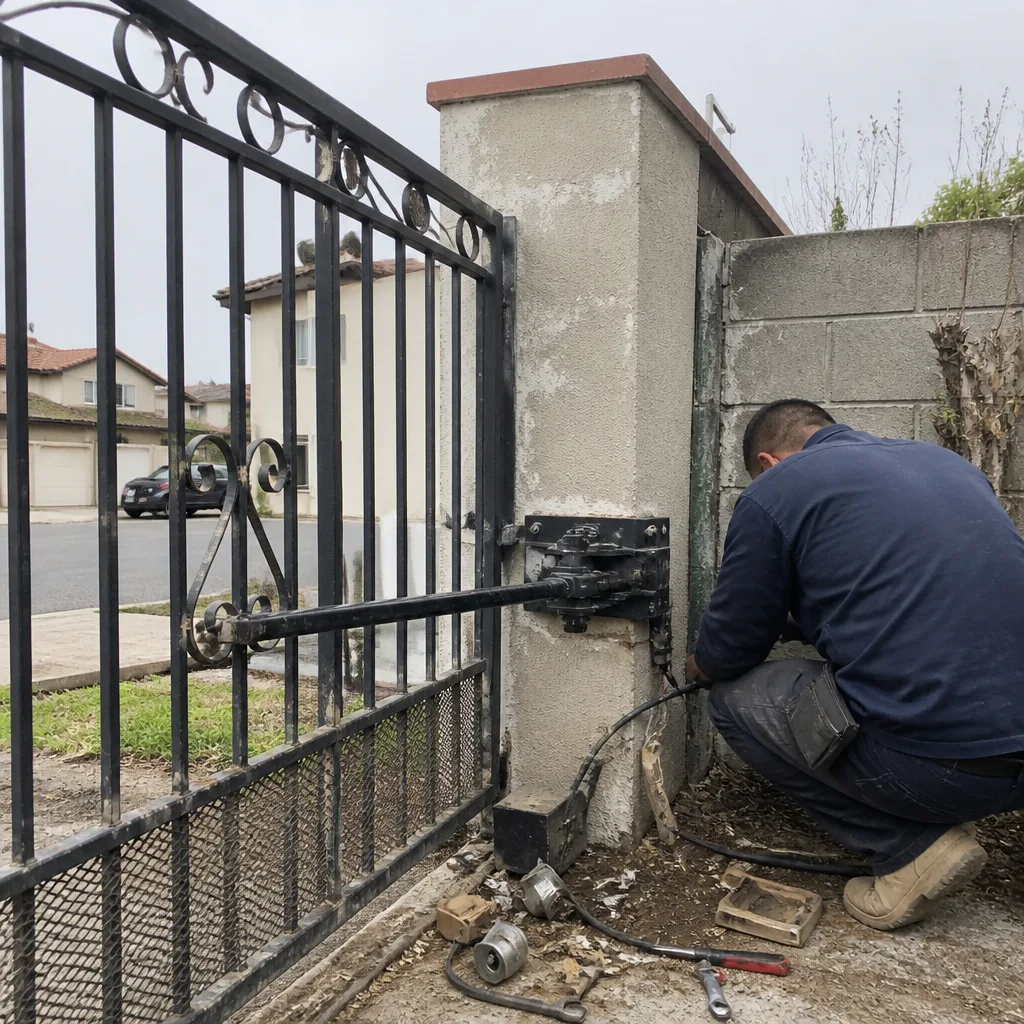 Before
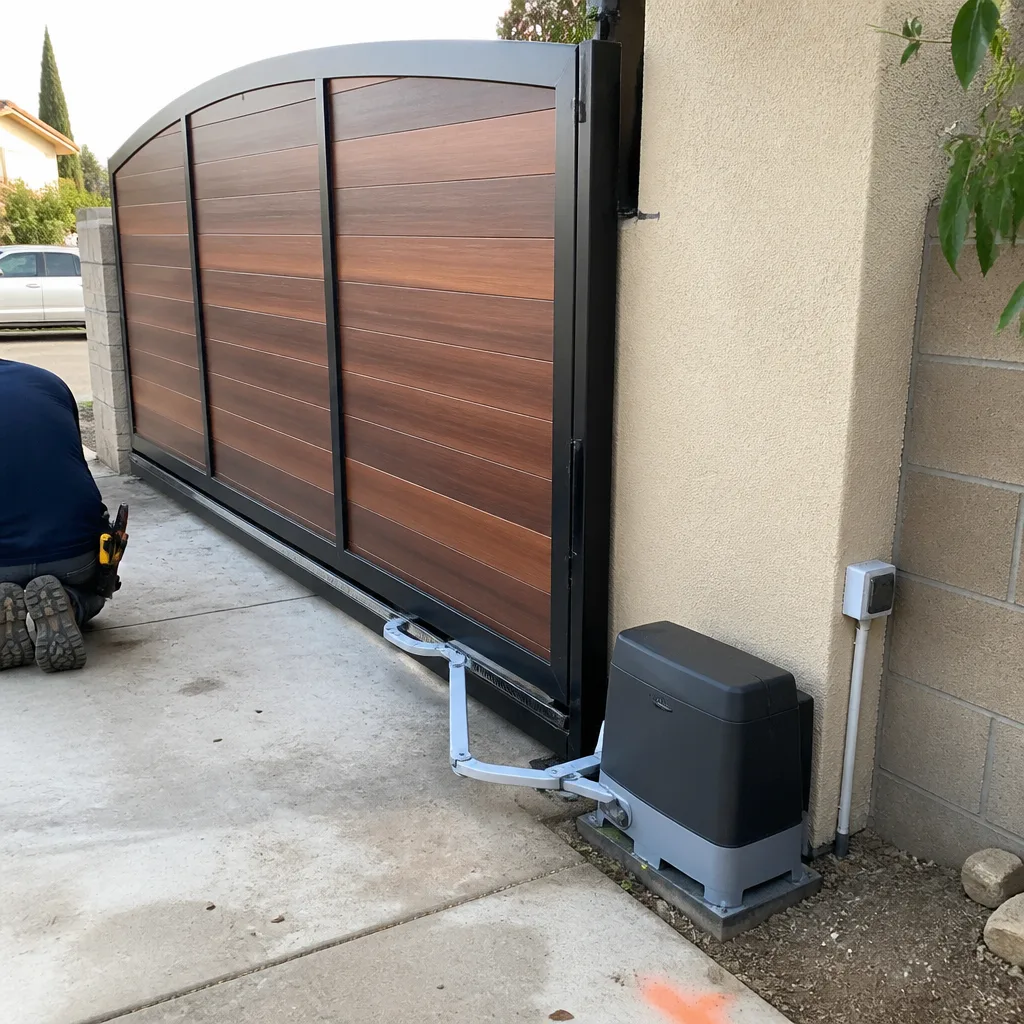 After
After Before
 After
AfterGate Repair Permits, Codes & Inspections in CA: What You Need to Know
Most California homeowners assume gate work is like fence work: no permit, no problem. That assumption is wrong in a very specific, expensive way. A gate operator replacement can trigger electrical permit requirements under the California Electrical Code even if the gate’s physical structure never changes. If that permit was skipped on your property, it surfaces during escrow as unpermitted work, and a buyer’s title company will flag it. This guide explains exactly where the permit line sits in California and Rancho Cucamonga specifically, so you can do the work once and own a house that sells clean. For Gate Repair Warning Signs: A Rancho Cucamonga Homeowner’s Reference Guide, see our companion post.
Quick Answer
Most mechanical gate repairs in California, including spring replacement, hinge repair, track realignment, and bolt-on operator swaps, require no permit. What does require a permit: any new electrical run to the gate, replacement of an operator with one drawing higher amperage than the existing circuit supports, structural changes to the gate itself (height, weight, material that alters foundation load), and installation of automated opening equipment on a gate that was previously manual. In Rancho Cucamonga, the governing documents run through the city’s Building & Safety division and, in many subdivisions, a parallel HOA architectural review process.
Table of Contents
- Where the Law Draws the Line: Repair vs. Alteration Under California Building Code
- When an Operator Swap Becomes an Electrical Permit in California
- How Rancho Cucamonga and San Bernardino County Handle Gate Permits
- HOA Approval vs. City Permits: Which One Governs and What Happens When They Conflict
- What Unpermitted Gate Work Means During a California Home Sale
- How to Retroactively Permit Gate Work a Previous Contractor Skipped
- The Specific Gate Modifications Contractors Fail to Mention Need Permits
- Common Mistakes to Avoid
- When to Call a Professional
- Frequently Asked Questions
- The Bottom Line
BeforeAfterWhere the Law Draws the Line: Repair vs. Alteration Under California Building Code
California Building Code (CBC) Chapter 1, Section 105 exempts “repairs” from permit requirements but defines the word narrowly. A repair restores something to its original condition. An alteration changes it. The distinction sounds academic until it costs you money. Replacing a worn hinge with the same hinge is a repair. Replacing a 14-foot swing gate with a 16-foot swing gate on the same posts is an alteration, because the weight on the footing changes, even though the gate looks almost identical.
Here is the practical threshold we see in Rancho Cucamonga and throughout San Bernardino County:
- No permit required: replacing springs, hinges, rollers, track, wheels, brackets, photo-eyes, keypads, pushbuttons, remotes, edge sensors, limit switches, and control boards (when the board is a same-spec replacement).
- No permit required: replacing a gate operator with one of the same voltage, same amperage draw, and same physical mounting configuration.
- Permit required: any new electrical branch circuit run to the gate location.
- Permit required: upgrading an operator from low-voltage DC to a higher-amperage AC unit that exceeds the existing circuit’s rated capacity.
- Permit required: adding automation to a gate that has never been automated.
- Permit required: changing gate height, width, material, or weight in a way that alters the load on existing footings or posts.
- Permit required: relocating the gate or posts.
The word that trips most owners in Rancho Cucamonga is “upgrade.” If your old FAAC operator drew 3 amps and the replacement BFT unit draws 5 amps, California Electrical Code (CEC) Article 430 demands the circuit be sized to the new load. If the existing circuit is 15-amp and the new operator, plus the accessory loop detector and edge sensors, still fits inside it, you may be fine with no permit. But once the branch circuit itself gets touched, or the operator’s nameplate amperage exceeds the circuit’s derated capacity, you have crossed into permit territory, and the inspector will check conductor size, conduit, and disconnect placement.
One more distinction that matters in Rancho Cucamonga specifically: this city has a mix of 1960s through 1990s-era subdivisions, many of which have original gate wiring that predates current low-voltage landscape lighting codes. If your gate’s existing power was run with UF cable without conduit and buried shallow, a new operator install may expose that deficiency even if the old one worked for decades. A permit inspection brings the run up to current code. That’s not a penalty; it is a correction that avoids a fire or nuisance tripping later.
When an Operator Swap Becomes an Electrical Permit in California
The rule is simple in principle and subtle in execution: replacing an operator in kind is exempt; changing the load is not. But here is what competitors rarely explain: the trigger is not the brand or the motor style. It is the nameplate amperage and the circuit’s ampacity. We document both on every operator replacement we perform under The Haven Standard, precisely because a future inspector or title company will want to see the arithmetic.
Three common scenarios in Rancho Cucamonga where an innocent “same for same” operator replacement turns out to be a permit event:
- Original operator is a low-voltage DC unit; the replacement is a 120V AC operator. This is a different class of installation. The original may have been powered by a small transformer plugged into a GFCI outlet. The new AC operator needs a dedicated circuit, a disconnect within sight of the motor, and a weatherproof enclosure. That is an electrical permit, full stop.
- The existing circuit is 15-amp and already carries gate lights or landscape transformers. California requires branch circuits feeding motor loads to be sized to 125% of the motor’s full-load current. If the old Viking unit pulled 8 amps and the new Linear pulls 12 amps, the 15-amp circuit is now undersized. You either run a new circuit (permit) or you choose a lower-draw operator (no permit, if the rest matches).
- The original operator was never permitted because the gate was installed before 2014 when the city updated its digital permit records. We see this constantly in Rancho Cucamonga’s older Alta Loma and central Cucamonga neighborhoods. The gate works fine, the operator dies, and suddenly the new job has to account for unpermitted original wiring. A conscientious inspector will require the whole feed to be brought up before signing off.
What this means for a homeowner: the gate industry’s habit of quoting “operator replacement” as a one-line item without asking about circuit amperage is the reason unpermitted work ends up in title reports. A contractor who never looks at the nameplate and never checks the breaker panel is guessing. Our technicians check both before any operator swap, photograph them, and write the numbers into the quote. That is Haven Standard Clause 1, have it in writing, applied to the electrical reality under the gate cover.
The inspector will want three things on any gate electrical permit in San Bernardino County: a disconnect switch within 50 feet and within sight of the operator, GFCI protection on any 120V receptacle within 6 feet of the gate’s public edge, and proper burial depth or protection for any new conduit. If the job is just an operator swap with no circuit change, there typically is no inspection at all. The permit office processes it as an “exempt repair” notation if the contractor files the right form.
How Rancho Cucamonga and San Bernardino County Handle Gate Permits
Rancho Cucamonga issues building permits through the city’s Building & Safety division, using the same online portal as San Bernardino County. A residential gate electrical permit in Rancho Cucamonga typically processes in 3 to 10 business days when the application is complete. The fastest path is an “Express Permit” for load-matched operator replacement, which can be issued same-day at the counter or online if the applicant can state the existing and proposed operator nameplate amperage.
The application path for a typical automated gate or operator electrical permit:
- Confirm jurisdiction. Most of Rancho Cucamonga is city jurisdiction. A few unincorporated pockets around the city edge fall under San Bernardino County Building & Safety instead. The address search on either portal tells you which.
- Gather the minimum data: existing operator make, model, voltage, amperage; proposed operator same four fields; circuit breaker size feeding the gate; photo of the gate and the existing panel. Incomplete applications are the number one reason for delay.
- File through the City of Rancho Cucamonga Building & Safety portal. Fee for a residential electrical permit of this type typically runs $160 to $350 in 2025, depending on circuit scope and whether an inspection is required.
- If new conduit or a new circuit is involved, schedule a rough-in inspection before covering any trench or drywall. Gate electrical is usually inspected alongside the final mechanical check of the operator.
- Keep the signed permit card. You will want it when you sell.
One Rancho Cucamonga-specific nuisance: many subdivisions in the city have HOA architectural review that runs in parallel with the city permit. The city does not check whether your HOA approved the gate style. The HOA does not check whether the city issued an electrical permit. You need both approvals when both apply. We have seen a homeowner in the Rancho Etiwanda corridor get a city electrical permit approved in a week, only to have the HOA reject the replacement gate’s powder coat color and stall the whole project for two months. When we handle Gate Repair in Rancho Cucamonga for HOA-governed communities, we ask about the architectural review status before the first truck rolls.
Inspection notes are also worth understanding. Rancho Cucamonga inspectors typically check gate installations for UL-listed operator components, proper bonding where metallic conduit runs underground, and the vehicle-sensing loop’s placement relative to the swing path. If you or your contractor skips the loop and relies only on the edge sensor, the inspector may flag it. Loop detectors on swing gates, especially the long residential arms common on Rancho Cucamonga hillside homes, are the difference between a gate that reverses for a car tire and a gate that keeps pushing.
HOA Approval vs. City Permits: Which One Governs and What Happens When They Conflict
They govern different things. The city permit governs safety and code compliance. The HOA approval governs appearance and, increasingly, technology choices. Neither can override the other. A city permit does not mean your HOA must accept the gate style, and HOA approval does not mean the city will waive the electrical code.
In Rancho Cucamonga, the conflict most often arises in master-planned communities like Victoria Gardens-adjacent developments and the newer tracts east of the 15. These HOAs often have design review committees with published gate specifications: specific solar panel placement for off-grid operators, specific operator enclosure colors, even specific keypad styles. A contractor who replaces a gate operator with a different physical footprint can inadvertently violate the CC&Rs, and the homeowners is the one who receives the violation letter, not the contractor.
What governs when they conflict:
- Code compliance: city permit always wins. The HOA cannot approve a gate configuration that violates California Building Code, even if the HOA’s design guidelines are more restrictive on appearance.
- Aesthetic requirements: HOA wins. The city does not care what color the gate is, whether the operator is a hydraulic FAAC or a linear-screw BFT, or whether the keypad is brushed nickel. The HOA can reject on any of those grounds.
- Process order: file the HOA request first, if your community requires it. HOA review cycles in Rancho Cucamonga typically run 2 to 4 weeks. The city’s electrical permit typically runs under two weeks. Starting the HOA first means both approvals land around the same time, and you are not paying a gate contractor to stand by.
- Installation enforcement: if you install an unpermitted gate that also violates HOA rules, you are exposed to both a code enforcement action from the city and a fines schedule from the HOA. Two different enforcement tracks, two different appeal processes.
One thing we tell Rancho Cucamonga owners up front: read the HOA filing before you choose a gate operator. Some communities limit motor types (no hydraulic units in certain HOAs because of fluid-leak concerns, for instance), which means a homeowner who already ordered a FAAC 750 could be forced to swap for a BFT Deimos or a Linear swing unit before work starts. When we handle Gate Installation in Rancho Cucamonga, we check the CC&R gate language during the estimate, not after the equipment arrives.
What Unpermitted Gate Work Means During a California Home Sale
California is a disclosure state. Under Civil Code Section 1102, sellers must disclose known material facts, and unpermitted work on the property is material. The standard California Association of Realtors Seller Property Questionnaire specifically asks whether any work was done without a permit. Many sellers check “no” because they were never told the gate operator replacement required one. The buyer’s title search then turns up the discrepancy, and the deal either re-trades or dies.
What title companies and mortgage underwriters look for on a California residential sale:
- Whether the gate’s electrical permit is recorded in the city or county database, and whether the permit is marked “finaled” (inspection signed off). An open permit is worse than no permit, because it signals work was started and never completed to code.
- Whether the gate addition changed the home’s improvement footprint. A new driveway gate with a new footing can affect setback or property-line concerns, which are title-adjacent issues even when the electrical is clean.
- Whether the gate operator is listed. Underwriters occasionally flag non-UL-listed operators as a hazard, which triggers a re-inspection demand before funding.
The cost consequence is real. Unpermitted electrical work in an escrow can trigger a retroactive permit with penalties, and San Bernardino County’s penalty schedule for retroactive permits on residential electrical runs typically doubles the original permit fee. A $250 permit becomes a $500 line item plus inspection call-out time. Some sellers absorb it. Others push it back on the buyer. Either way, the seller’s net proceeds go down.
We have helped Rancho Cucamonga sellers resolve unpermitted gate work before listing. The work is usually correctable in a week or two: a licensed contractor files the retroactive permit, opens the junction boxes for inspection, the inspector verifies conductor size and grounding, and the permit finales. Then the seller can honestly mark “no” on the unpermitted-work question and hand the finaled permit to the buyer’s agent. It is one of the cheapest clean-ups in a California escrow when it is caught before the buyer’s inspector finds it.
How to Retroactively Permit Gate Work a Previous Contractor Skipped
The path back to a clean permit record in San Bernardino County is straightforward, but it depends on how far the original work went and whether it is safe. The earlier you start, the less it costs.
- Document what exists. Photograph the gate operator nameplate, the breaker feeding it, the conduit or cable path, the disconnect (if any), and the trench or stub-out. These photographs establish the as-built condition an inspector will compare against code.
- Hire a licensed contractor or a licensed electrician to open the permit. Some homeowners file their own retroactive permits, but an inspector will ask more questions of an owner-builder. A professional can represent the work as “existing, undocumented, requesting retroactive approval,” which is the correct filing language.
- Expect a field inspection. The inspector will check conductor ampacity against the operator’s nameplate load, grounding and bonding, GFCI requirements, disconnect placement, and whether the circuit is properly protected. If the original installer used undersized wire or buried UF cable without conduit, the correction could involve a new run.
- Pay the permit fee plus any penalty. In San Bernardino County, residential electrical retroactive permits on gate circuits typically run $300 to $800 all-in, including penalty and inspection, depending on scope. That is far cheaper than an escrow re-trade.
- Keep the finaled permit card and the inspector’s sign-off in the house file. This is the document a buyer’s agent will ask for. It ends the conversation.
We apply this documentation discipline on every job, even non-permit repairs. Under The Haven Standard Clause 4, every visit from Gate Motor & Opener in Rancho Cucamonga leaves a photo log and a written part-by-part record. If you later need to open a retroactive permit, the evidence is already assembled. That is the difference between a two-week clean-up and a three-month argument with the county about what was installed and when.
The Specific Gate Modifications Contractors Fail to Mention Need Permits
The gate industry has a blind spot, and it costs homeowners money. Contractors quote the visible work and stay silent about the code triggers. Here are the five modifications we see most often in Rancho Cucamonga that should have been permitted but were not, either because the contractor did not know or did not want the inspection delay:
1. Adding automation to a previously manual gate
A manual driveway gate with no operator is just a fence on hinges. The moment a motor goes on, California code classifies it as a “power-operated gate,” and the entire install changes category. UL 325 compliance is required, which means photo-eyes, force-sensitivity, and a reversing mechanism. The electrical feed is new, so the electrical permit is mandatory. Yet a striking number of Rancho Cucamonga homeowners have automated gates installed with no permit and no UL 325 compliance, and they do not find out until the gate does not reverse for a child’s bicycle or until a home inspector flags it before a sale.
2. Raising gate height on an existing frame
In California, adding 12 inches of vertical height to a driveway gate changes the wind-load calculation, which changes the required footing depth. Rancho Cucamonga sits at the base of the San Gabriel Mountains, and the Santa Ana winds that funnel through the Cajon Pass regularly move gates that were never engineered for added sail area. A gate that was fine at 5 feet can become a lever arm at 6 feet, and the original footing eventually works loose. If the height change exceeds the CBC alteration threshold, the city wants an engineering letter. Most contractors skip it.
3. Changing from a swing gate to a slide gate
A slide gate does not swing; it tracks. The difference in foundation design is enormous. Sliders require a continuous footing carrying bearing rollers and a guide post, often at a different elevation than the original swing footing. This is not a repair; it is a new gate system. In Rancho Cucamonga, where many 1970s-era driveways have a downward slope from the street to the garage, slide gates also introduce drainage questions when the bottom track crosses the swale. The city permit triggers on the new concrete and the new electrical, and an HOA may also have something to say about the track’s visual footprint.
4. Intercom and access-control integration on a shared or secondary gate
Adding a keypad, card reader, or telephone-entry system to a gate often means pulling low-voltage cable through conduit. If that conduit is new, it falls into the permitting discussion. But the less obvious trigger: gates serving multi-residence parcels in California can fall under a different code section if the gate creates a fire-access control point. The fire department’s key-override requirement (Knox box or equivalent) applies to gated communities and private roads, and even a two-house shared driveway gate in Rancho Cucamonga can trigger it if the gate blocks emergency vehicle access. An access-control retrofit without a fire override can fail a fire marshal review, and we have seen the correction order come attached to a home sale.
5. Solar-powered operator retrofits
California loves solar, and solar gate operators are common on the hillside lots of north Rancho Cucamonga where no line voltage ever reached the gate pillar. The permitting question is not the solar panel; it is the low-voltage run from the panel to the operator and the battery enclosure. Some counties treat off-grid solar gate operators as exempt from electrical permits; others require a structural review of the panel mounting on the existing pillar. San Bernardino County generally wants the panel’s mounting method documented, and the city may also flag the glare angle onto the public street. A solar gate operator is a good solution, but it is not automatically permit-exempt just because it is low voltage.
Common Mistakes to Avoid
- Assuming “same brand, same model” means no permit. If the new unit is the same model but the old circuit was sized wrong, the permit office still wants the correction documented. Same-for-same is not a magic pass.
- Filing the HOA request after the city permit. If the HOA rejects the gate style, the city permit becomes a document for a gate that cannot be built. Run the HOA request first when your community requires it.
- Selling a house in Rancho Cucamonga with an open gate permit. An open permit is worse than no permit. Underwriters treat it as incomplete construction. Close it before listing.
- Letting a contractor bury the conduit before the rough-in inspection. In San Bernardino County, the inspector must see the trench with the conduit exposed. Once it is covered, you are either digging it back up or filing an owner-verified affidavit, which many inspectors dislike.
- Choosing an operator without checking the nameplate amperage. This is the most common unpermitted-work generator in the gate trade. The old Linear draws 4 amps; the new Viking draws 9; nobody checks, the permit is never pulled, and the title company finds it later.
- Treating a gate upgrade as a fence job. A gate is not a fence. A fence does not have a motor, does not have photo-eyes, does not have a reversing requirement. California code treats them differently, and so do city inspectors.
- Paying cash for a gate job with no written scope. The written scope is what lets a future inspector, title officer, or lawyer understand what was actually done. We deliver the written price and the written record on every job under Haven Standard Clause 1. No written scope, no evidence.
When to Call a Professional
Call a licensed gate contractor when the job touches the permit threshold in any way: new automation on a manual gate, a different-amperage operator, gate height or material changes, new power runs, access-control integration, or a solar retrofit. These are the jobs where the permit question is not academic, and getting it wrong follows you to escrow. A professional should be able to name the permit trigger during the estimate, not discover it halfway through the job. Vance our Gate Repair services in Rancho Cucamonga offers free estimates in Rancho Cucamonga. Call (909) 764-3720 and we will tell you, in writing, whether your gate job needs a permit, what it will cost, and how long the approval path runs.
Frequently Asked Questions
Not always. If you are replacing the operator with one of the same voltage and same or lower amperage draw, and you are not touching the electrical feed, most California jurisdictions treat it as a repair and no permit is required. If the new operator draws more current than the existing circuit supports, or if you are adding a new circuit, you need an electrical permit. In Rancho Cucamonga, the threshold test is the operator nameplate amperage against the circuit’s 125% motor-load requirement.
Yes, for genuine repairs. Replacing a hinge, a wheel, a spring, a photo-eye, or a remote-receiver board does not require a permit or a contractor. What you should not do yourself is anything that touches the line-voltage feed, the conduit, the disconnect, or the operator’s internal motor wiring. Gate operators mingle 120V, 24V, and ground inside the same enclosure; a wrong connection can create a shock hazard on the gate itself. We recommend a licensed professional for any operator or electrical work. Call (909) 764-3720 for a free estimate.
For a typical operator replacement with a new circuit run, the permit fee in San Bernardino County usually lands between $160 and $350, plus inspection scheduling if an inspector visit is required. Retrofitting unpermitted work typically doubles the fee once penalties apply. The exact number depends on circuit scope and whether the city or the county has jurisdiction at your address. We quote the permit fee as a separate line item so you know exactly what the county charges and what the labor costs.
In most Rancho Cucamonga master-planned communities, yes. The HOA governs the gate’s visual design and sometimes restricts operator types, enclosure colors, and solar panel placement. The city governs the electrical and safety code. You need both, and the HOA often takes longer. File the HOA request first.
Yes, and it often shows up twice. A sharp home inspector will note the lack of a UL 325 compliance sticker, missing photo-eyes, or an operator without a visible disconnect. Separately, the title company may run a permit search on the property and flag any gate-related permits that are open or missing. Unpermitted gate work is one of the most common escrow objections we help Rancho Cucamonga sellers resolve before listing.
Use the City of Rancho Cucamonga Building & Safety online portal or the San Bernardino County permit lookup, depending on your jurisdiction. Search by address. You are looking for a finished electrical permit tied to the gate or driveway, with a “finaled” status. If you cannot find one and you have an automated gate, assume the original work may be unpermitted and get a retroactive permit opened before you list the house.
The Bottom Line
California gate permits come down to one question: did the work change the load, the structure, or the electrical feed? If no, you are likely in repair territory and no permit applies. If yes, you need a permit, and skipping it creates a title problem that surfaces at the worst possible moment. In Rancho Cucamonga, the city’s permit path is efficient and the fees are modest, which makes skipping a permit a poor trade. Know the nameplate amperage, check the circuit, file the HOA request early, keep the finaled permit card, and call (909) 764-3720 when the threshold is unclear. Browse our more guides & resources for related topics. A written answer costs nothing and beats an escrow surprise.
Written by Adrian Vance, Owner at Vance Gate Repair Rancho Cucamonga, serving Rancho Cucamonga since 2014.