
Last updated September 20, 2026
Free on-site gate assessment - hinges, posts, and your LiftMaster or Nice gate operator checked before anything is quoted
The assessment is free and the quote is the invoice.
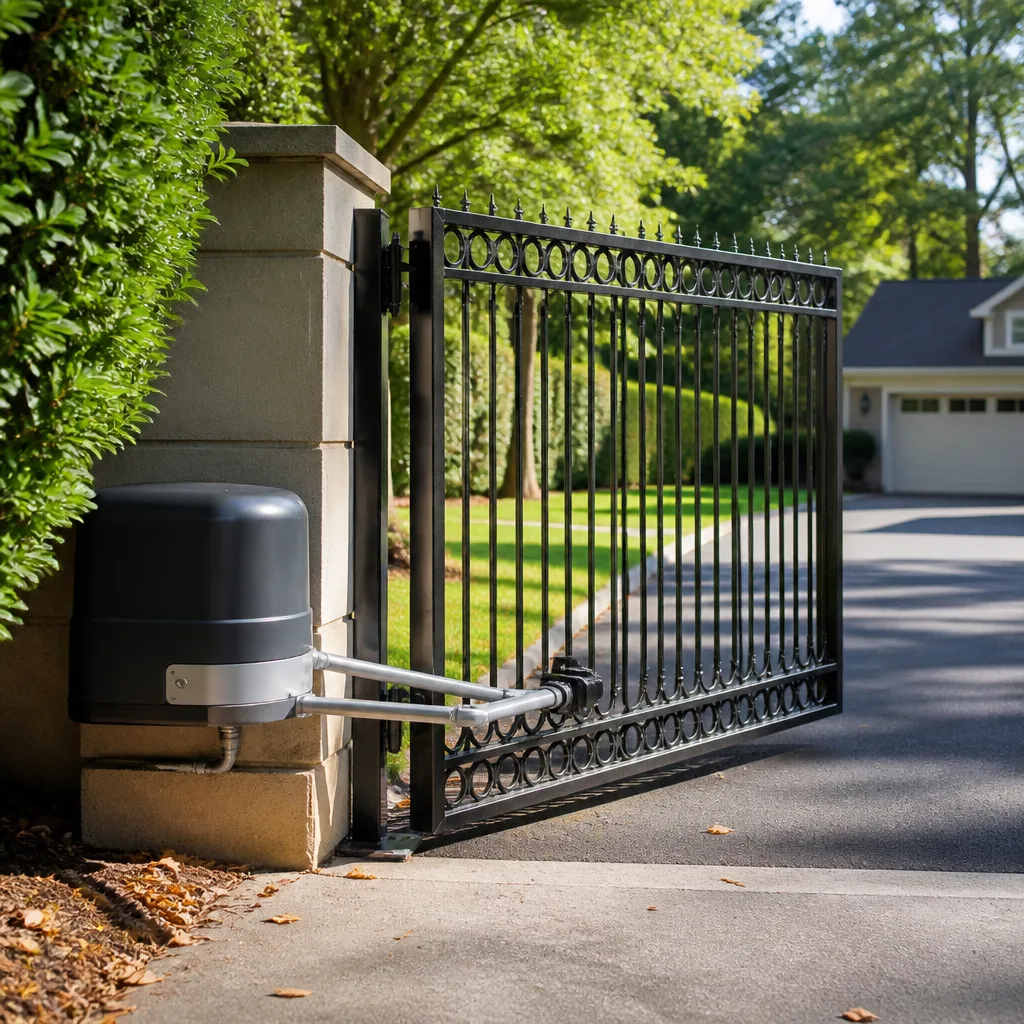
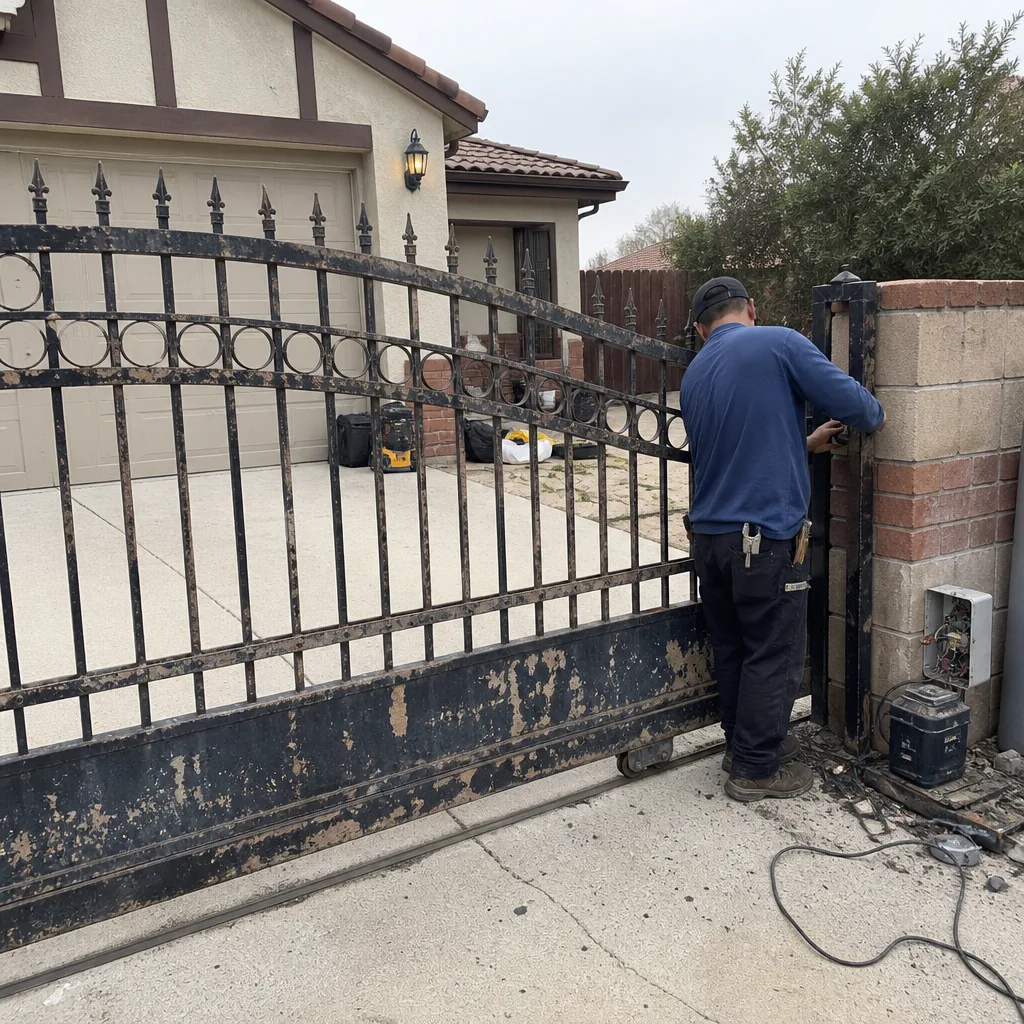 Before
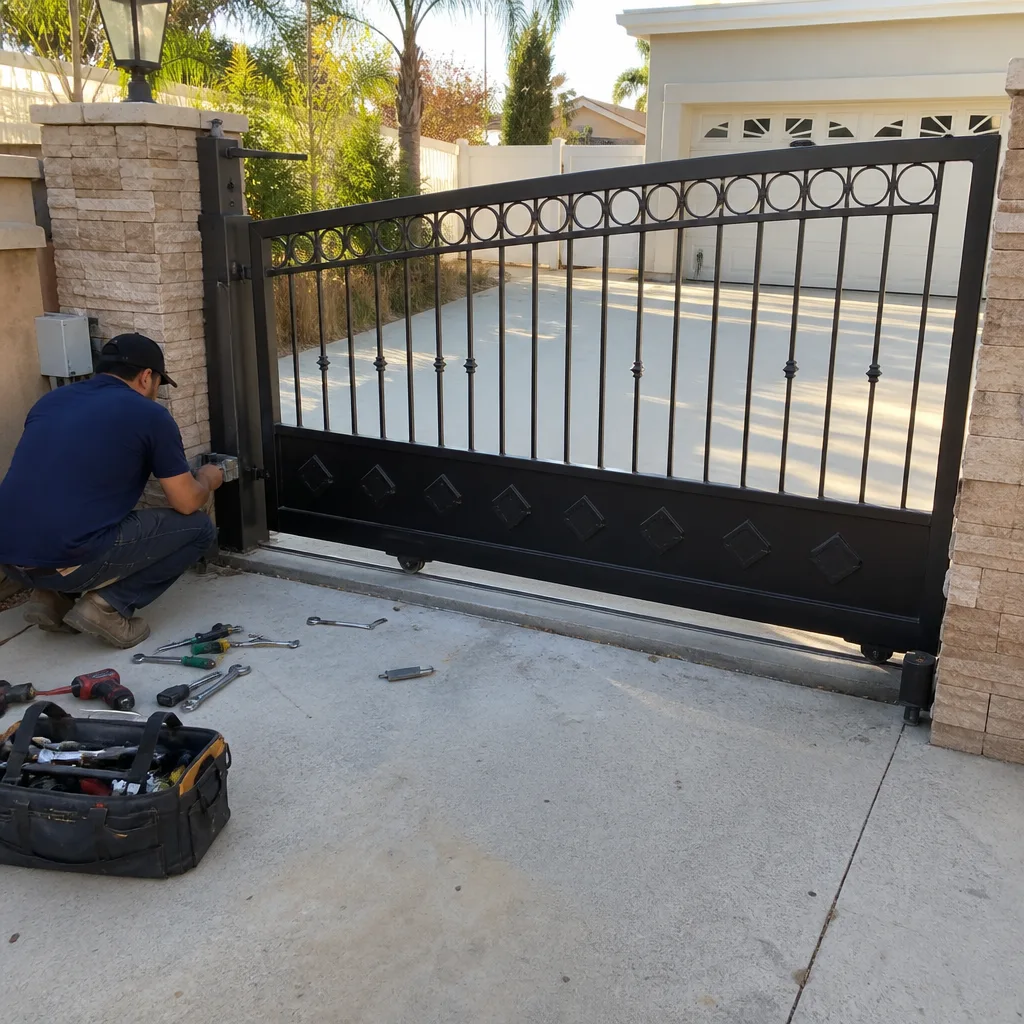 After
After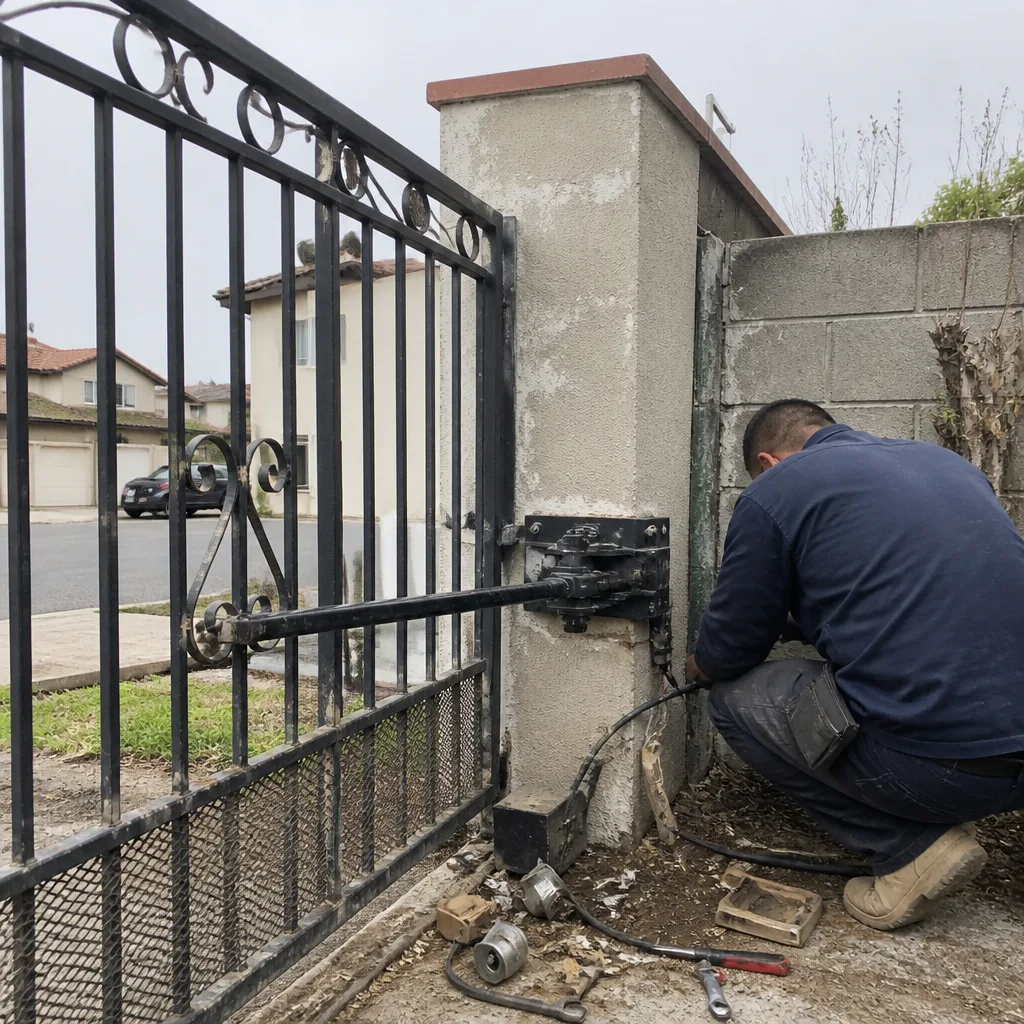 Before
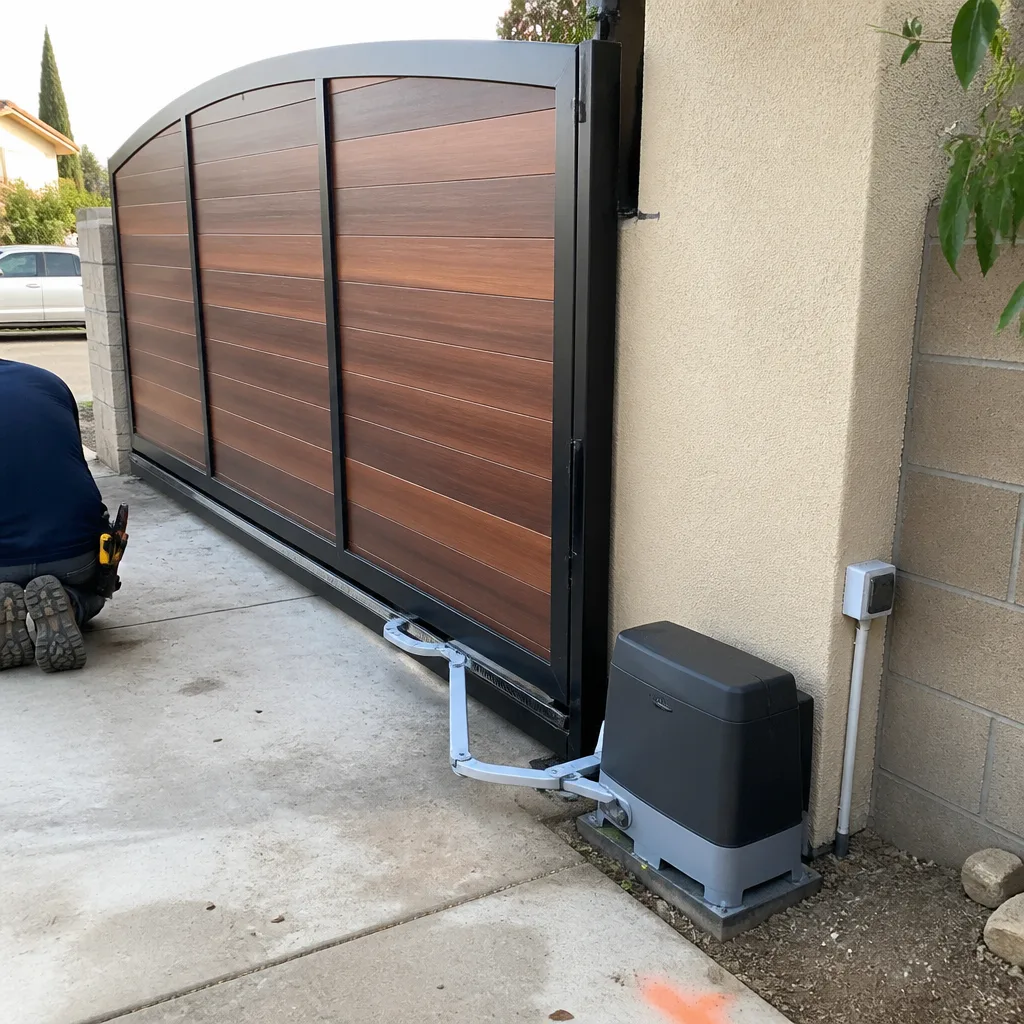 After
After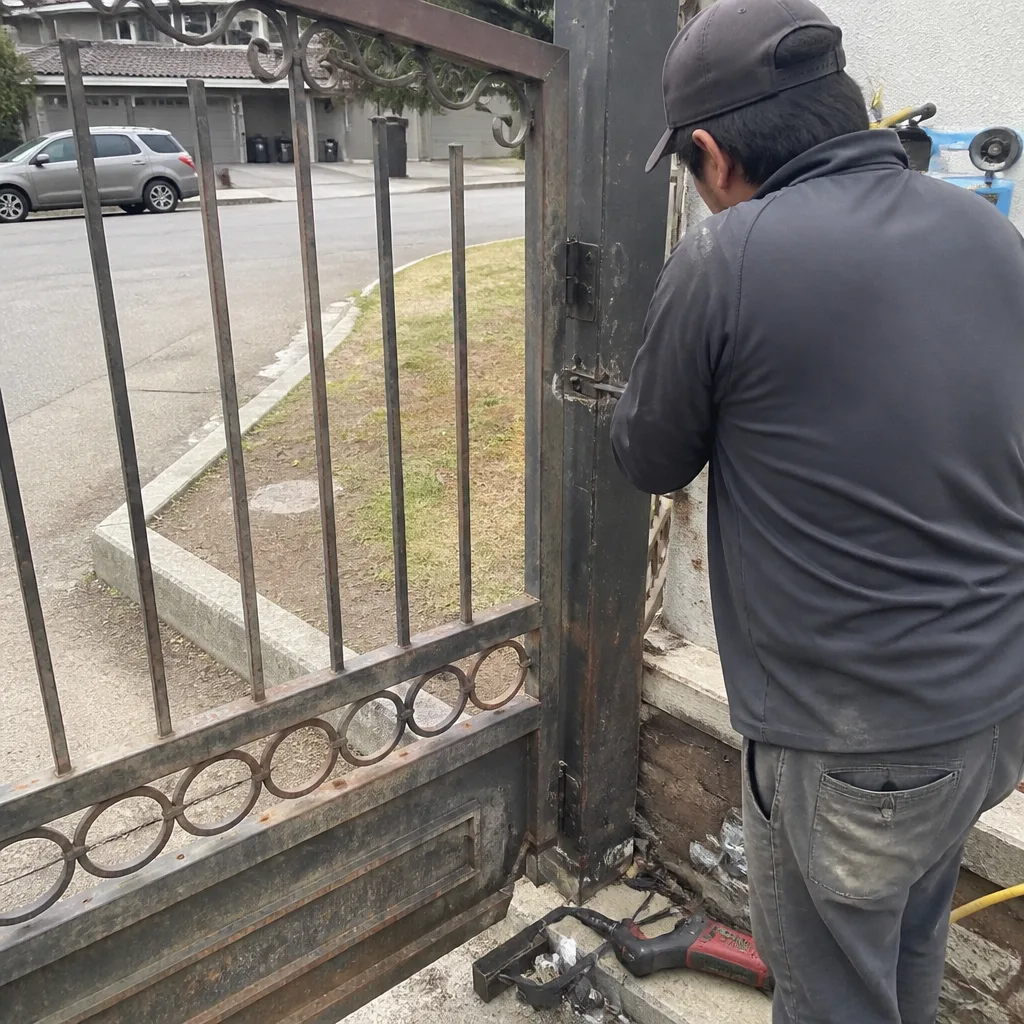 Before
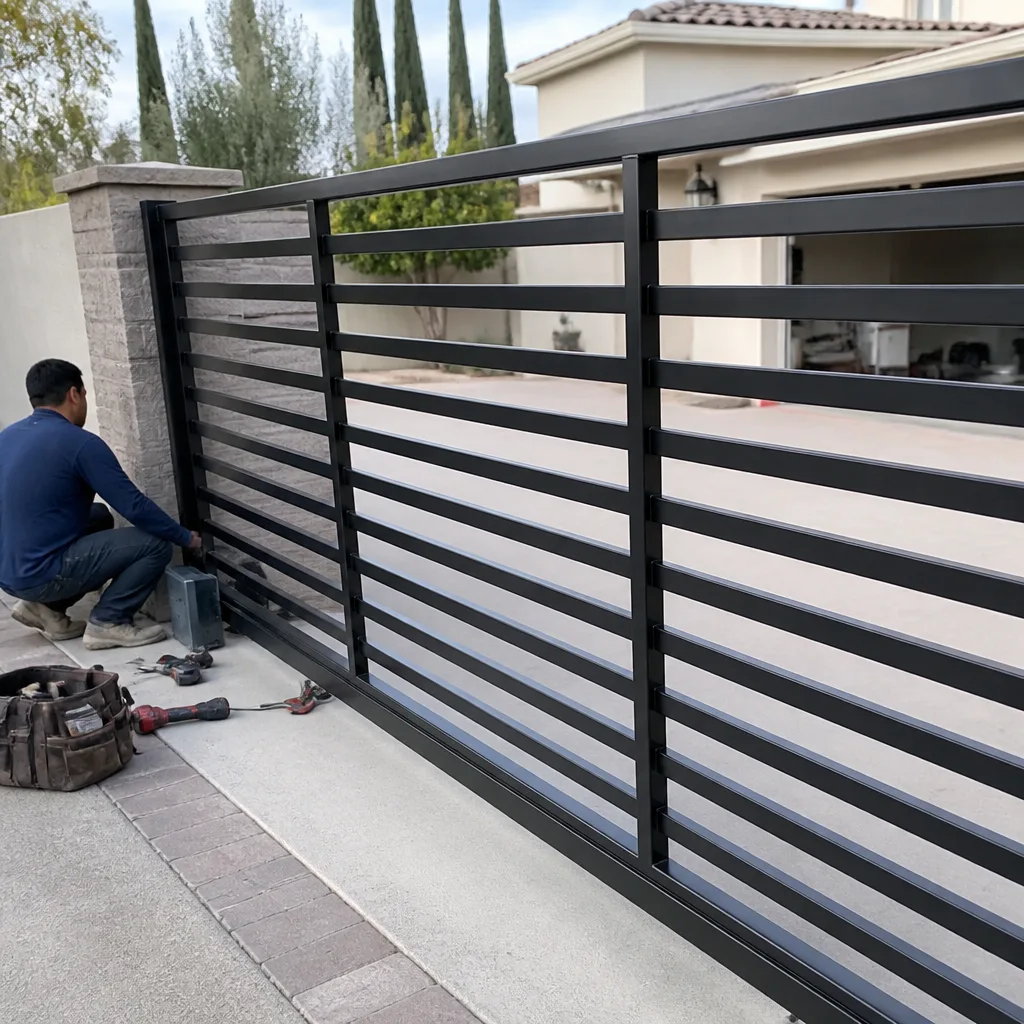 After
AfterGate Repair Warning Signs: A Rancho Cucamonga Homeowner’s Reference Guide
A gate that reverses mid-cycle without obstruction is almost always described by homeowners as a “glitch.” It gets ignored for weeks until the operator burns out its thermal overload relay, turning a $90 sensor adjustment into a $400 board replacement. In Rancho Cucamonga, where summer heat pushes gate motors harder than coastal climates ever will, the margin between “monitor it” and “replace it” is measured in days, not months. This guide gives you a three-tier severity system, the five sounds your gate makes and what each one means, why afternoon failures are a heat signature rather than a ghost, and how to photograph a symptom so a technician can diagnose it before rolling a truck.
Quick Answer
The gate repair warning signs that matter in Rancho Cucamonga fall into three tiers: Tier 1 symptoms you log and monitor, Tier 2 symptoms you schedule within 30 days, and Tier 3 symptoms that mean stop using the gate manually and call a technician today. The fastest way to know which tier you’re in is to listen: grinding means the rack or chain is wearing, clicking means the control board is receiving a command but not executing it, and silence-when-commanded on a hot afternoon usually means a thermal cutoff tripped. For a deeper walkthrough, see How to Hire a Gate Repair Contractor in Rancho Cucamonga: A Step-by-Step Guide. If your gate reverses without obstruction, groans under load, or fails only in the heat of the day, you have a documented, dateable symptom, not an intermittent mystery.
Table of Contents
- The Three-Tier Severity System for Gate Symptoms
- The Five Sounds a Gate Makes and What Each One Indicates
- Why Your Gate Fails in the Afternoon: Heat-Related Symptoms, Not Ghosts
- How to Photograph and Document a Warning Sign for Remote Diagnosis
- Rancho Cucamonga Conditions That Accelerate Gate Wear
- Gate Motor and Opener Warning Signs by Brand
- Photo-Eye and Safety Sensor Warning Signs
- Track, Hinge, and Hardware Warning Signs
- Common Mistakes to Avoid
- When to Call a Professional
- Frequently Asked Questions
- The Bottom Line
BeforeAfterThe Three-Tier Severity System for Gate Symptoms
Most gate warning sign lists fail because they treat every symptom with the same urgency. That’s not how gates actually fail. A gate that’s slightly slow in January is a different animal than a gate that’s slightly slow in August. In Rancho Cucamonga, where daytime highs routinely cross 100 degrees from June through September, a symptom that could wait three months in a coastal climate might be three weeks from a hard failure here. We’ve organized the symptoms below by what they actually demand of you.
Tier 1: Log It, Monitor It
These symptoms mean the gate is communicating that something is beginning to change, but it’s not yet a functional problem. You should note the date, time, temperature, and what you observed. If the symptom recurs or worsens, move it up a tier.
- A gate that runs 1-2 seconds slower than it did last month. Motors lose speed gradually as capacitors age. Log it. If it gets slower in the next 30 days, that’s a Tier 2.
- A faint hum from the operator when the gate is at rest. A transformer hum at idle is normal for many units. If the hum becomes audible from inside the house, that changes things.
- Small rust spots on the gate frame, especially at weld points. In Rancho Cucamonga’s dry climate, rust is less aggressive than coastal regions, but sprinkler overspray against a gate post creates the same oxidation cycle. Touch-up paint now beats a weld repair later.
- A gate that opens fully but closes to within two inches of the stop and then settles. This is often a limit switch drifting, not an immediate mechanical failure. Photograph the gap. If it grows, schedule a service call.
Tier 2: Schedule a Repair Within 30 Days
These symptoms mean a component is measurably degrading. The gate will keep working, but every cycle adds wear that expands the eventual repair bill. Thirty days is a reasonable window; beyond that, you’re gambling with the operator.
- The gate reverses mid-cycle without anything in the path. This is often a photo-eye alignment issue or a force-sensitivity setting that drifted. The part cost is typically under $150. Left alone, the reversal cycle repeatedly trips the motor’s overload relay, and a $90 sensor adjustment becomes a $400 board replacement. This is the single most common escalation in Rancho Cucamonga gate repair.
- The gate bangs against the stop or the ground when closing. The limit switch is no longer stopping travel at the right point. Each hard stop delivers a shock load to the motor, the chain or rack, and the gate hinges. You’re adding wear to at least three components every time it closes.
- A clicking sound from the operator when you press the remote, but no gate movement. The control board is receiving the signal. The problem is downstream: a capacitor, a motor start circuit, or a seized drive. This is diagnosable in a single service visit, and it’s typically repairable rather than a replacement.
- The gate opens, stops, and then drifts back a few inches. This is usually a brake or clutch adjustment that’s out of spec. On incline driveways, which are common in the foothill neighborhoods of Rancho Cucamonga, drift is a safety issue as well as a wear issue.
Tier 3: Stop Using the Gate Manually and Call Today
These symptoms mean the gate is no longer safe to leave in automatic operation, and in some cases, it’s not safe to move manually either. Disengage the operator and secure the gate in a fixed position, then call. A live person answers at Vance Gate Repair Rancho Cucamonga home 24 hours a day.
- The gate reverses and then continues to cycle back and forth without stopping. This is a control board fault or a limit switch failure. Each cycle is another shock load on every mechanical component. Disconnect power to the operator immediately.
- Any sound of metal-on-metal grinding that’s new or suddenly louder. Something is physically wearing against something else. A chain dragging on a sprocket, a rack tooth breaking, or a wheel bearing disintegrating. Each cycle removes material that cannot be put back.
- The gate sags visibly when it’s halfway open. This means a hinge or a wheel has failed or is failing. A gate that drops while moving is a crushing hazard, and in a Rancho Cucamonga neighborhood with kids and pets, that’s an unacceptable risk.
- Smoke, a burning smell, or a tripped breaker associated with the gate. This is an electrical fault, not a mechanical one. Do not reset the breaker and try again. The fault will still be there, and the second attempt is where boards and transformers actually burn.
- Any sparking or visible arcing at the operator, the keypad, or the junction box. This is an immediate electrical safety issue. Kill power at the breaker and call a technician.
The Five Sounds a Gate Makes and What Each One Indicates
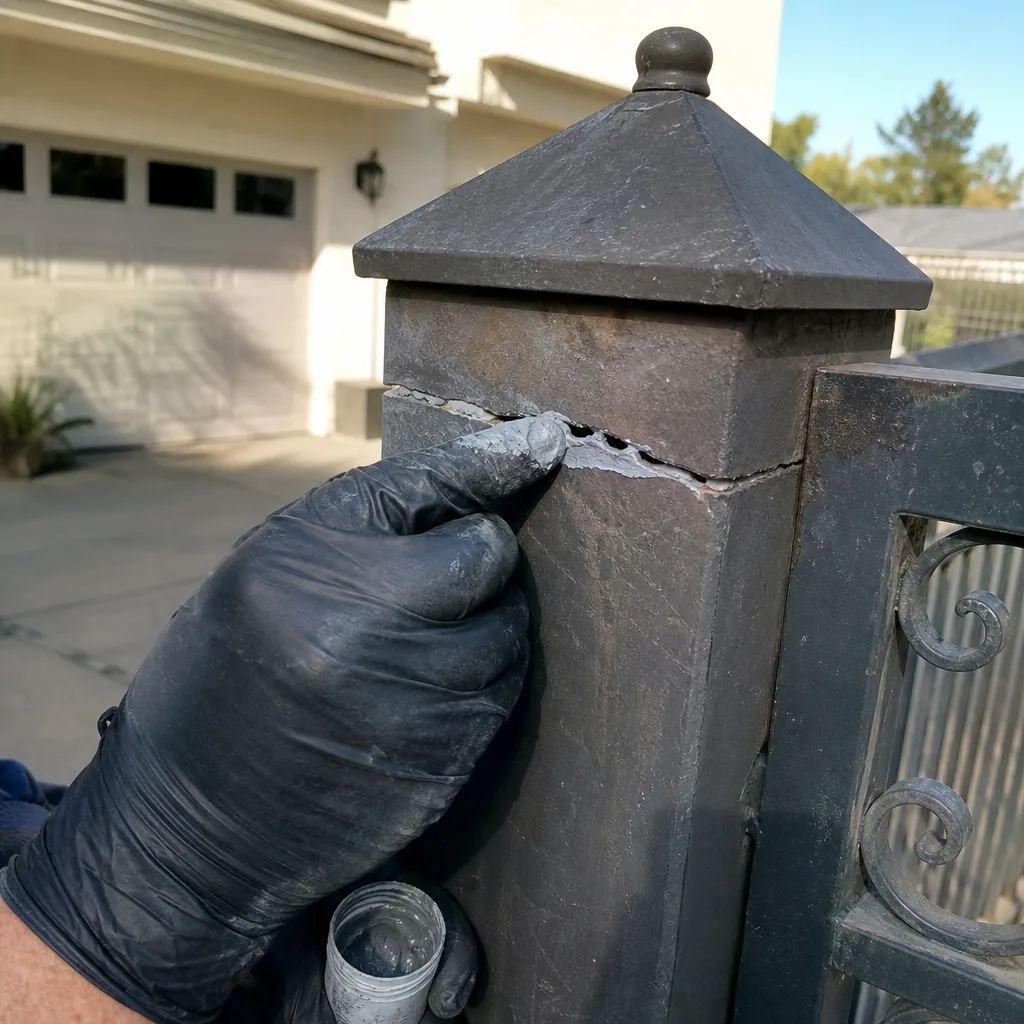
Sound is the most underused diagnostic tool a homeowner has. Before you call a technician, stand next to the gate while it completes one full open-and-close cycle. What you hear will direct the conversation more precisely than any description of “it’s not working right.” In our experience, the sound tells us which subsystem is involved about 70% of the time before we even open the operator cover.
- Grinding. A rough, uneven, metal-against-metal sound that changes pitch as the gate moves. Grinding means something is physically wearing: a chain dragging against a sprocket, a rack gear with broken teeth, or a wheel bearing that has lost its lubrication. In Rancho Cucamonga, where dust from the Santa Ana winds coats every exposed surface, grinding accelerates fast because the dust acts as an abrasive paste. This is a Tier 2 or Tier 3 symptom depending on severity.
- Clicking. A clean, sharp, repetitive click from the operator box when the remote is pressed. The control board is receiving the command and energizing the relay, but the motor isn’t turning. This is an electrical or capacitor issue, not a mechanical one. It’s repairable in most cases, and it won’t fix itself. Clicking is a Tier 2 symptom that becomes Tier 3 if it’s accompanied by any heat or burning smell.
- Squealing. A high-pitched, consistent sound that often appears when the gate starts moving or when it’s under load, like on a slight incline. Squealing points to a belt slipping, a pulley that’s dry, or a chain that’s too tight. On swing gates, it can also be a hinge pin that’s lost its grease. In the dry heat of a Rancho Cucamonga summer, lubrication fails faster here than in humid climates. This is a Tier 1 or Tier 2 symptom: address it before it becomes a grinding sound.
- Thudding. A single impact sound when the gate reaches the end of its travel. A properly adjusted gate slows down and stops against the limit without impact. A thud means the limit switch is mis-set or has drifted, and the gate is hitting its physical stop at full speed. Every thud is a shock load through the motor, the drive, and the hinges. This is a Tier 2 symptom that becomes more expensive with every cycle.
- Silence when commanded. You press the remote or the keypad, and nothing happens: no click, no hum, no movement. Silence means the command isn’t reaching the operator, or the operator has no power. Check the breaker and the keypad batteries first. If those are fine, silence is a Tier 3 electrical issue. In Rancho Cucamonga’s heat, a thermal overload can also produce silence when the motor has been working hard and the ambient temperature is high, which we’ll cover next.
Why Your Gate Fails in the Afternoon: Heat-Related Symptoms, Not Ghosts
A gate that works fine in the morning but fails in the afternoon is not an intermittent ghost problem. It’s a heat signature. In Rancho Cucamonga, where summer temperatures routinely exceed 100 degrees, the afternoon is when thermal load peaks. Components that operate fine at 70 degrees behave differently at 110 degrees, and the difference is predictable if you know which parts are thermally sensitive.
Here’s what’s actually happening. The motor windings generate heat every time the gate cycles. That heat dissipates through the motor housing and into the surrounding air. When the ambient temperature climbs past about 95 degrees, the motor can no longer shed heat as efficiently. The windings get hotter. The insulation on the windings degrades faster. The motor’s internal thermal cutoff, a small heat-sensitive switch, eventually trips and shuts the motor down. That’s your afternoon failure.
The same principle applies to the control board. Capacitors, which store and release the energy needed to start the motor, are rated for a specific temperature range. In sustained heat, capacitors dry out and lose capacitance. They still work in the morning when the board is cool, but by mid-afternoon, when the board itself is heat-soaked, the capacitor can no longer provide the start pulse. The result is a click with no movement, or no response at all.
Three components fail under thermal load in a predictable order:
- Capacitors. First to go. They’re the most heat-sensitive component on the board. A failing capacitor produces slow starts, weak movement, or a hum without motion before it fails completely.
- Thermal overload relays or internal motor cutoffs. Second to go. These are designed to trip to protect the motor. If they’re tripping regularly in the afternoon, the motor is overheating, and the underlying cause is usually a mechanical load that’s too high or a capacitor that’s no longer providing clean start power.
- Control board solder joints. Third to go. Repeated heat cycling expands and contracts the board, which eventually cracks solder joints. The symptom is intermittent: the gate works, then doesn’t, then works again. By the time a solder joint fails visibly, the board usually needs replacement.
If your gate fails in the afternoon and works again after sunset, that’s not a stroke of luck. It’s the thermal cutoff resetting as temperatures drop. The next time the gate runs hot, the failure will come earlier in the day and last longer. This is a Tier 2 symptom that becomes Tier 3 quickly in Rancho Cucamonga. Schedule the repair before the failure becomes permanent.
How to Photograph and Document a Warning Sign for Remote Diagnosis
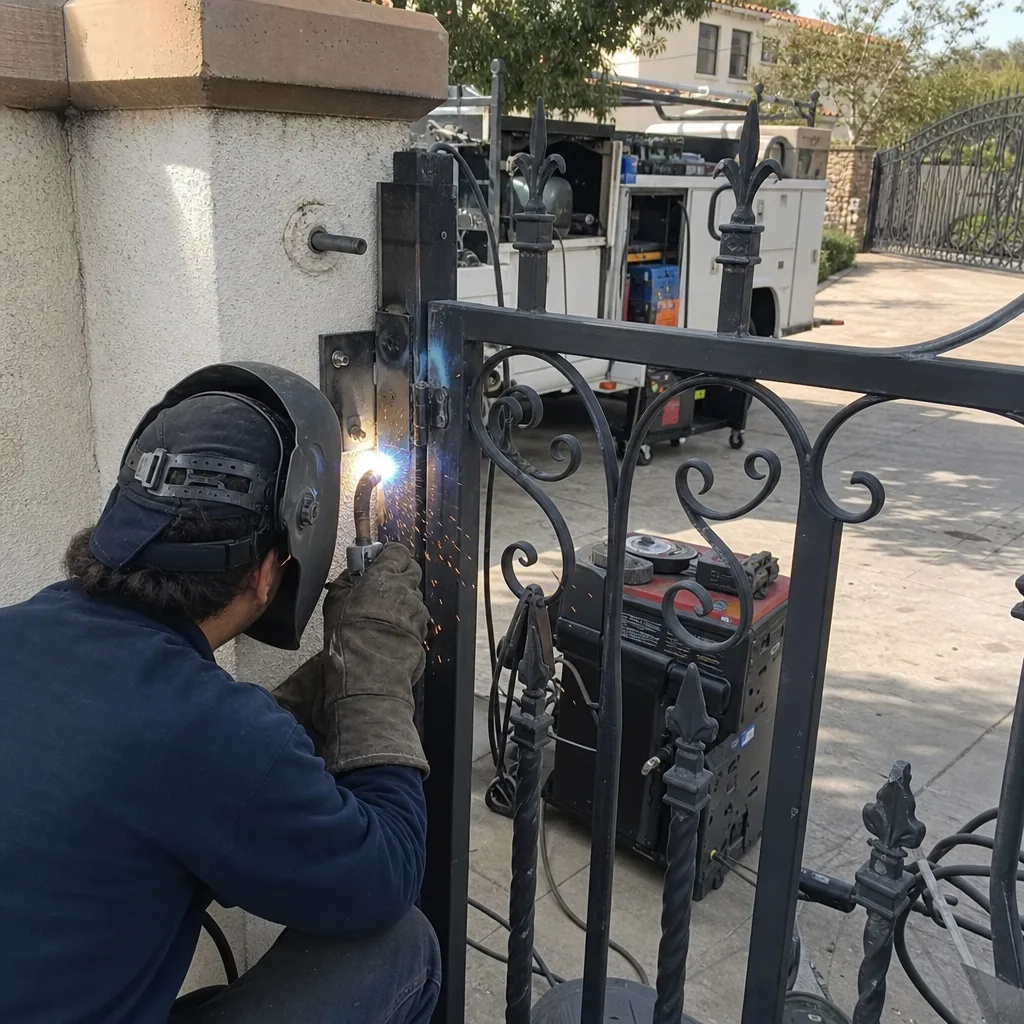
Most technicians can diagnose a large percentage of gate problems from photographs if the right information is in the frame. The difference between a useful photo and a useless photo is not camera quality. It’s composition and context. Here’s exactly what to capture, in order.
- Stand back and photograph the entire gate from the front, gate closed. Include the full gate leaf, both posts, and the ground beneath the gate. This gives the technician the gate type, construction, and approximate weight class. A swing gate and a slide gate have entirely different failure modes.
- Photograph the operator and its mounting, with the cover on. Stand close enough that the brand name and model number are legible. Do not open the operator cover. The model number tells the technician which board, which motor, and which parts are likely inside. This is where knowing that a gate is a Mighty Mule MM571W versus a DoorKing 9150 changes the diagnostic conversation before the truck rolls.
- Photograph the drive mechanism: chain, belt, rack, or screw. For a slide gate, photograph the rack gear along the gate’s length, especially the first and last three feet, where wear concentrates. For a swing gate, photograph both hinge points and the arm or piston that drives the leaf.
- For a reverse or sensor symptom, photograph the photo-eye alignment. The photo-eye is the small infrared sensor pair mounted on opposite posts near the ground. Photograph both sensors in a single frame if possible, or two photos showing each sensor’s angle. Note whether anything has shifted: a sprinkler head, a plant, a rock, or a child’s toy.
- Photograph the symptom itself, if it’s visible. A sag, a gap, a rust spot, a broken wheel, a chain off a sprocket, a crack in a weld. Put something in the frame for scale, like a quarter for a rust spot or a tape measure for a gap.
- Write a three-line note to attach to the photos. Include the date, the time of day, the outside temperature, and what the gate was doing or not doing. “Gate opens but reverses at 2 PM, 104 degrees, no obstruction” is a complete diagnostic clue. “Gate is broken” is not.
At Gate Repair in Rancho Cucamonga, we ask for these photos before dispatch. It lets the technician arrive with the right parts on the truck, and it gives the homeowner a written record of what was observed before anyone touched anything. That record matters when the same symptom recurs, because it tells a future technician exactly what the gate was doing at a specific date and temperature, not what someone remembers it doing six months later.
Rancho Cucamonga Conditions That Accelerate Gate Wear
Rancho Cucamonga’s climate is not neutral to gate hardware. The city sits in the Inland Empire, where three conditions combine to accelerate symptom progression in ways that a homeowner in Huntington Beach or Newport Beach never experiences.
Heat. The most obvious and the most damaging. Summer daytime highs above 100 degrees are the norm from June through September, and heat-soaked afternoons are when motors run hottest and capacitors fail first. The thermal cycling also expands and contracts metal gate frames daily, which loosens bolts, cracks welds, and drifts limit switches faster than stable coastal temperatures ever would.
Dust and Santa Ana winds. From October through March, Santa Ana events blow dry, fine dust and sand across the city. That dust settles into chain links, sprockets, hinge pins, and slide-gate rollers. Mixed with grease, it forms an abrasive paste that accelerates mechanical wear. A chain that would last eight years in a clean coastal environment might last five in a Rancho Cucamonga neighborhood that catches regular wind. Photographs of a dust-caked drive mechanism are some of the most common we see on service calls.
UV exposure. Rancho Cucamonga averages over 280 sunny days per year. That UV load degrades plastic sensor housings, keypad faces, and control board enclosures. Photoelectric sensors that sit in direct afternoon sun will yellow, become brittle, and eventually crack. The symptom is usually a gate that reverses for no apparent reason, because a UV-damaged sensor lens refracts the infrared beam just enough to trigger a false reversal.
The practical takeaway is this: if a symptom would be a “watch it for a couple months” item in a moderate coastal climate, it’s a “schedule within 30 days” item here. The environment is working against the hardware every day, and the compounding effect of heat, dust, and UV shortens every timeline in this guide.
Gate Motor and Opener Warning Signs by Brand
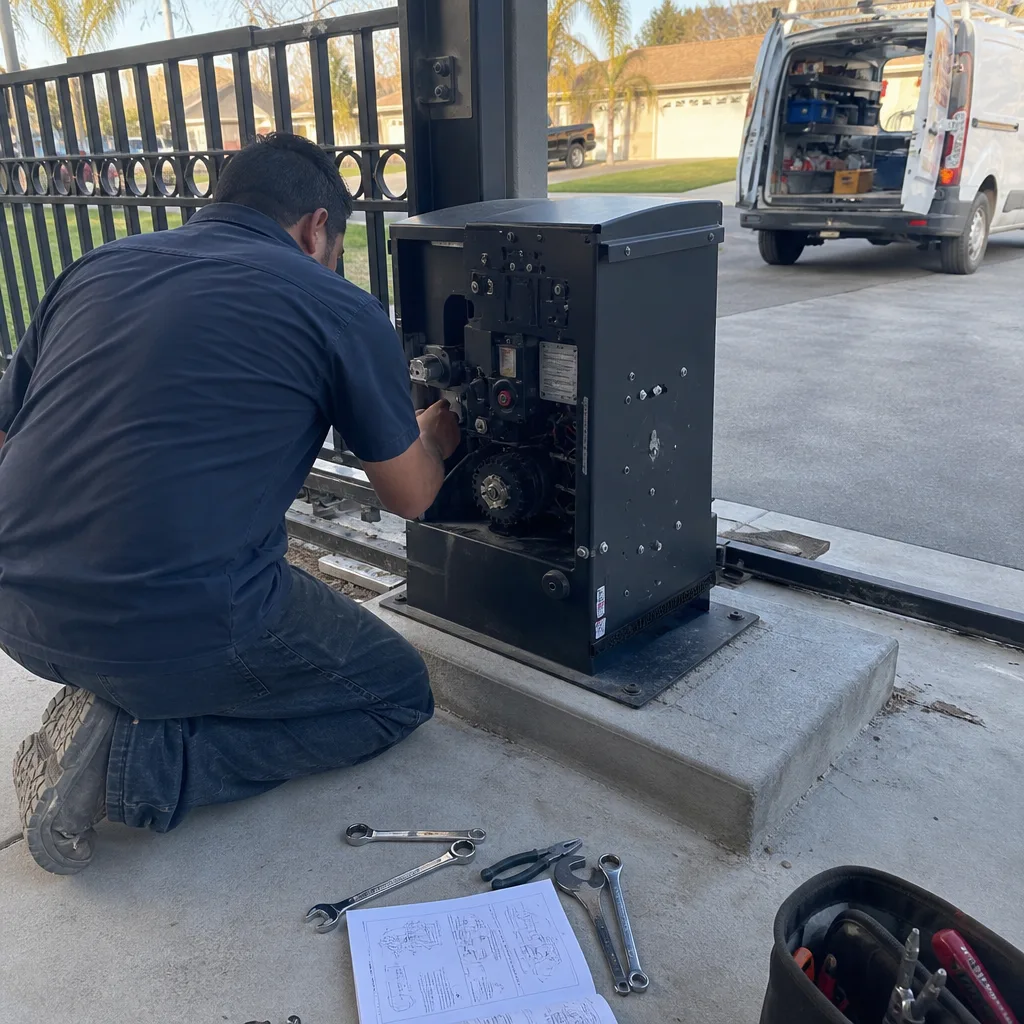
Different automation brands fail in different ways, and knowing which brand is on your gate helps you interpret the symptom. Vance Gate Repair services all of these, and our diagnostic process starts with the brand and model before we assume anything about the failure. Here are the common warning patterns for four brands we see frequently in Rancho Cucamonga.
Ghost Controls. These operators are popular on residential swing and slide gates because they’re DIY-friendly, but the most common failure pattern we see is a gradual loss of travel distance. The gate opens to 80%, stops, and then the remote needs to be pressed again. That’s a limit switch or travel module issue, and it’s repairable. Ghost Controls units also tend to be sensitive to low battery voltage in the remote, so before assuming the board is bad, replace the remote battery and re-test.
DoorKing. DoorKing builds commercial-grade operators, and the residential installs in Rancho Cucamonga are often older units in the foothill communities, where driveway grades are steeper. The classic DoorKing warning sign is a gate that strains on the incline and then trips the thermal overload. That strain is usually mechanical: a hinge binding, a wheel dragging, or a chain tension problem, and it will kill the motor if left untreated. DoorKing units also use a master/slave photo-eye configuration, and the slave sensor failing is the most common cause of false reversals.
Elite. Elite operators are known for quiet belt or screw drives on larger gates. The warning sign we see repeated is a gate that starts smoothly and then develops a rhythmic vibration halfway through travel. That’s usually a belt tension issue or a screw drive that’s running dry. Elite units with the plug-in loop detector installed are also sensitive to electrical interference from nearby landscape lighting transformers, which can cause the gate to open on its own. If your gate opens by itself at night, check what’s plugged into the same circuit before blaming the board.
Mighty Mule. Mighty Mule is the most common residential opener in the Inland Empire, and the failure mode we see most often is a board that’s been killed by a lightning strike or a power surge. The inland areas of Rancho Cucamonga see dry lightning events in the summer, and a direct or nearby strike will take out the control board while leaving the motor and the rest of the gate perfectly functional. The symptom is usually a completely dead operator with no click, no hum, and no response. The fix is a new board, which is a straightforward repair, not a replacement gate.
If you’re not sure what brand is on your gate, Gate Motor & Opener in Rancho Cucamonga covers all of them, and the brand name and model are always the first things a technician records on the job.
Photo-Eye and Safety Sensor Warning Signs
Photo-eyes, also called photo sensors or safety beams, are the infrared emitter and receiver pair mounted near ground level on either side of the gate opening. They’re the component that stops the gate if a person, pet, or car is in the path. When they fail, they fail in two directions: the gate reverses with nothing there, or the gate refuses to close at all.
The first failure mode, false reversal, is by far the more common in Rancho Cucamonga. Here’s what causes it here, in order of frequency:
- Misalignment from ground shift or a bump. A car bumping the post, a root pushing against a concrete pad, or simply the earth settling can move one sensor out of alignment by as little as an inch. The beam misses the receiver, the operator reads it as an obstruction, and the gate reverses. This is usually a 10-minute fix.
- Dust or spider webs on the sensor lens. Rancho Cucamonga’s dust load means sensor lenses need cleaning more often than the manufacturer’s maintenance schedule suggests. A dusty lens diffuses the beam and produces intermittent false reversals that are hard to reproduce because they depend on wind and temperature.
- UV damage to the lens or housing. Direct afternoon sun over several summers turns the plastic cloudy or yellow, which degrades the beam. The symptom is usually a gate that reverses every afternoon in the summer months and works fine in winter, because the UV angle and heat are the trigger.
- Wiring damage between the sensor and the control board. Rodents, landscape work, or UV-cracked insulation can compromise the sensor’s power or signal wiring. The symptom is often intermittent: the gate works after a rain and fails when it’s dry, because the moisture temporarily bridges a gap in a cracked wire.
The second failure mode, a gate that refuses to close, is the sensor failing safe. The operator thinks the beam is always broken, so it holds the gate open or reverses it immediately. This is a safety feature working correctly. The problem is in the sensor circuit somewhere, and it’s repairable. A gate that won’t close is not a board problem in most cases.
What you can do before calling: clean both sensor lenses with a dry cloth, check that nothing is physically blocking the beam path, and note whether the small indicator lights on the sensors are on and what color they show. That information, photographed, tells the technician whether the problem is power, alignment, or the lens itself.
Track, Hinge, and Hardware Warning Signs
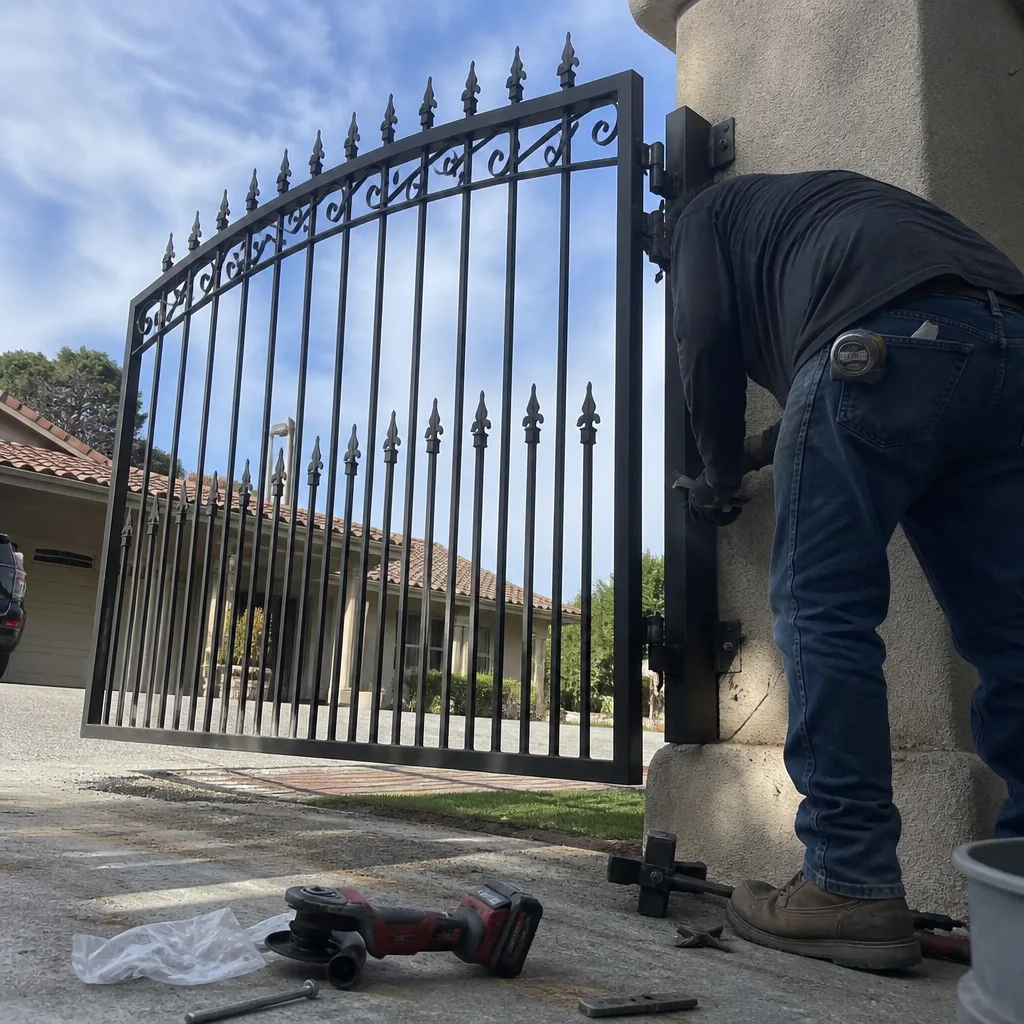
The motor and the sensors are the components homeowners worry about, but the physical hardware, the track, the hinges, the wheels, and the chain, is where most mechanical failures actually begin. A motor doesn’t burn out on its own. It burns out because the mechanical load behind it became too heavy.
Slide gate track warning signs. Slide gates run on wheels along a track, or on a cantilever system. The track is exposed to everything: dust, leaves, irrigation overspray, and the occasional car tire. Warning signs include: a gate that slows down at the same point in its travel every cycle (a wheel is binding or a track section is bent), a gate that wobbles side-to-side as it moves (wheel bearings are wearing), and a gate that makes a rhythmic thumping as it rolls (a flat spot on a wheel or debris packed into the track). Any of these adds load to the motor and should be addressed before the operator bakes itself trying to push through the resistance.
Swing gate hinge warning signs. Swing gates hang on hinge posts, and everything the gate weighs is carried by those hinges. Warning signs include: a visible sag that makes the gate drag the ground or miss the latch, a creaking sound from the hinge area during travel, and a gate that’s harder to move manually than it used to be. On a heavy ornamental iron gate, which is common in the newer Rancho Cucamonga developments, a failing hinge is a genuine safety issue. The gate can drop without warning.
Chain and belt warning signs. Chain drives stretch over time and need periodic tension adjustment. A loose chain makes a slapping sound and adds shock load to the sprockets. Belt drives don’t stretch much, but they do crack with age and heat exposure. A belt with visible cracks is on a countdown to snapping, and when it snaps, the gate is stuck wherever it is. Replacement belts are inexpensive; the damage a snapped belt does to surrounding components can be less so.
The documentation standard we use at Gate Installation in Rancho Cucamonga, photographing what was found and what was adjusted, exists precisely because hardware warning signs are easy to record but hard to remember. A photo of a track with a bent section, taken in March, explains why the gate was binding by August.
Common Mistakes to Avoid
- Ignoring a reversing gate because it “still works.” A gate that reverses mid-cycle is trying to tell you the safety circuit is compromised or the force settings are wrong. Every day it reverses, the motor and the drive take abuse that shortens their service life. The reversal is the warning; the motor replacement is what happens when you ignore it.
- Lubricating a gate without cleaning it first. Spraying grease or penetrating oil onto a dusty chain or track in Rancho Cucamonga makes the problem worse. The lubricant mixes with the dust into an abrasive compound that accelerates wear. Clean first, then lubricate with the right product for the component, not whatever’s in the garage.
- Resetting a tripped breaker and trying again. A breaker that trips on a gate circuit tripped for a reason. Resetting it and running the gate again is how small electrical faults become burned boards and transformers. The fault doesn’t clear itself; it just gets a second chance to do more damage.
- Assuming an old gate needs to be replaced. Most gate symptoms we see are repairable. A control board, a capacitor, a sensor, or a wheel is a $100 to $400 repair. A full gate replacement starts at several thousand. The decision to replace should be based on a written diagnosis, not on a symptom that looked scary.
- Opening the operator cover to take a look. Inside the operator box is live electrical wiring, capacitors that store charge even after the power is off, and adjustments that can make the gate more dangerous, not less. Photograph the outside, note the model number, and let a trained technician do the opening. High-tension components and stored electrical energy are the reason professionals carry insulated tools and follow a specific procedure. This is a safety boundary worth respecting.
- Waiting until the gate stops working completely to call. The cheapest repair is the one scheduled while the gate still moves. A grinding sound is a $200 repair today and a $600 repair in six weeks, because the grinding component takes out the component next to it before it finally fails. Call when the gate is still working poorly, not when it’s not working at all.
- Describing the symptom as “it’s broken.” A technician who arrives with no information has to spend paid diagnostic time reproducing a symptom the homeowner could have photographed in two minutes. The three-line note, date, time, temperature, and what happened, is the cheapest diagnostic tool in gate repair.
When to Call a Professional
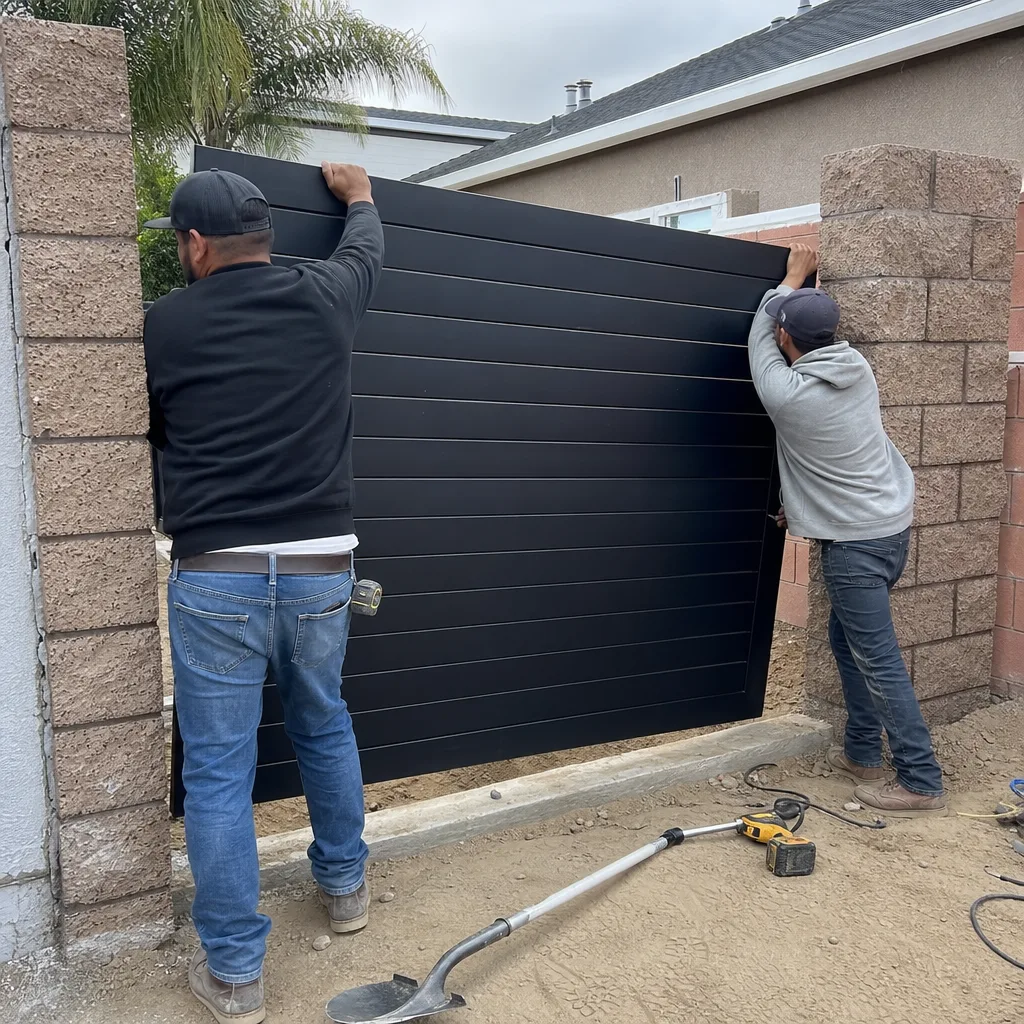
Call a professional when the symptom falls into Tier 2 or Tier 3, when you hear grinding, clicking, or silence-when-commanded, when the gate fails in the afternoon heat, or when a safety sensor is causing false reversals. You should also call if you’re unsure which tier a symptom belongs in. A good gate company will tell you over the phone whether the symptom sounds like a monitor-it or a schedule-it, and it won’t charge you for that conversation. Vance Gate Repair Rancho Cucamonga offers our Gate Repair services with free estimates in Rancho Cucamonga. Call (909) 764-3720, and a live person will answer. We’ll ask for the photos described in this guide, give you a written price before any work starts, and leave you with a documented record of what was found, what was set, and what was installed.
Frequently Asked Questions
Most residential gate repairs in Rancho Cucamonga run between $150 and $600 depending on the component, with sensor alignments and limit switch resets at the lower end and control board replacements at the higher end. A written price is provided before any work begins, so the number you’re quoted is the number you’ll pay. Call (909) 764-3720 for an exact quote on your gate, and the estimate is free.
A gate that reverses with no obstruction usually means the photo-eye sensor is misaligned, the lens is dirty or UV-damaged, or the force sensitivity setting has drifted too low. It can also be a wiring fault between the sensor and the control board. The sensor system is doing its job by refusing to close; the fix is in the sensor circuit, not the motor. Call (909) 764-3720, and we’ll diagnose it from photos before rolling a truck.
A gate that works in the morning and fails in the afternoon is showing a heat-related symptom. The motor windings or the control board capacitors are overheating and tripping a thermal cutoff, and the part resets when temperatures drop. In Rancho Cucamonga’s summer heat, this pattern becomes more frequent and then permanent without repair. Call (909) 764-3720, and have the symptom documented with the outside temperature noted.
Most gate operators can be repaired. Control boards, capacitors, limit switches, gears, and belts are all replaceable components, and the repair is usually a fraction of the cost of a new operator. The decision to replace should be based on a written diagnosis of what failed and why. Vance Gate Repair services LiftMaster, FAAC, BFT, Linear, Viking, Ghost Controls, DoorKing, Elite, and Mighty Mule units and will give you a written price for the repair before any work starts.
A photo-eye sensor, also called a safety beam, projects an infrared beam across the gate opening and stops the gate if anything breaks the beam. In Rancho Cucamonga, photo-eyes fail most often from dust on the lens, UV degradation of the plastic housing, or misalignment from ground shift. Cleaning the lens and checking alignment are the first steps. If the sensor still fails, call (909) 764-3720, and we’ll identify the cause and the fix.
No. A grinding noise means metal is wearing against metal, and every cycle removes material you can’t put back. The component that’s grinding today is taking out the component next to it, and the eventual bill grows with each cycle. Stop using the gate in automatic mode, disengage the operator if you know how, and call (909) 764-3720 for a same-day diagnosis in Rancho Cucamonga.
The Bottom Line
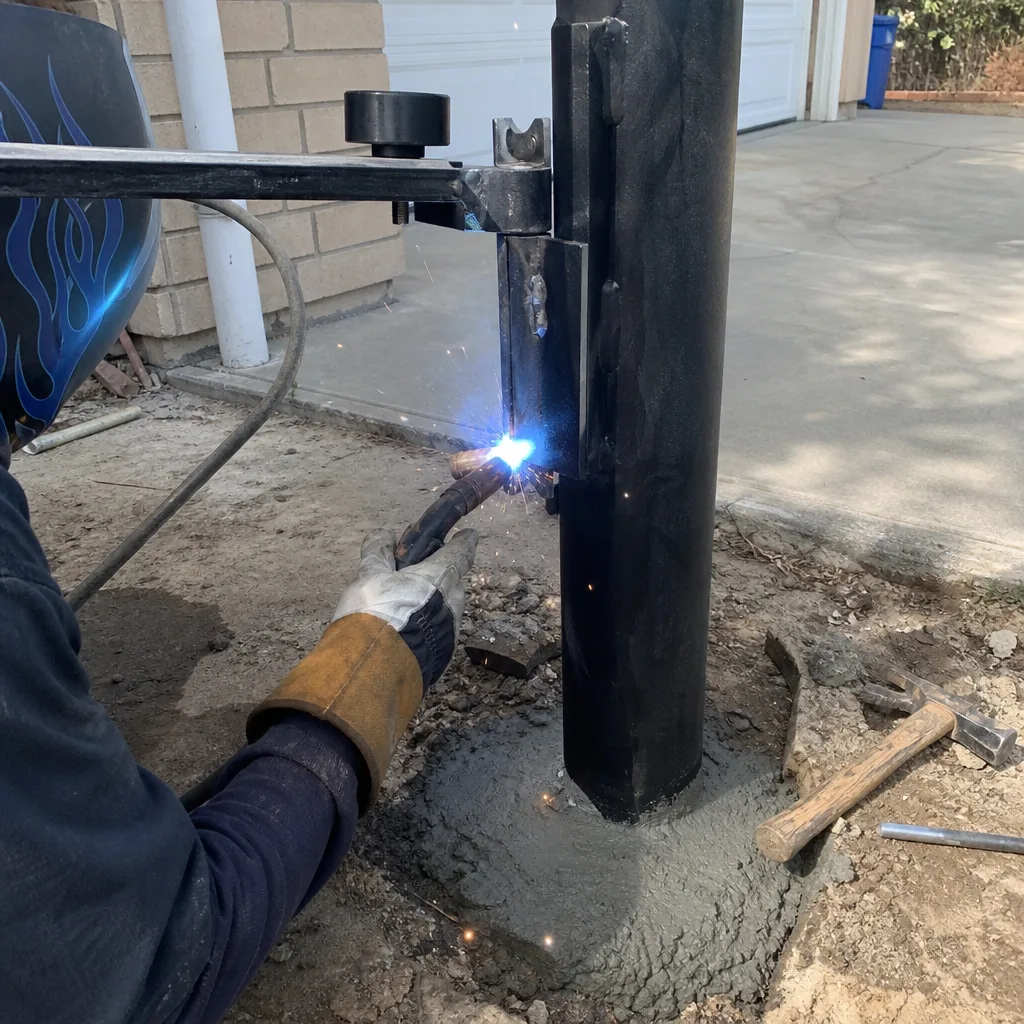
Gate warning signs are only useful when they tell you what to do and when to do it. Tier 1 means log it and watch. Tier 2 means schedule within 30 days. Tier 3 means stop and call today. The five sounds, grinding, clicking, squealing, thudding, and silence, each point to a different subsystem, and knowing which one you’re hearing gets you a faster, cheaper diagnosis. In Rancho Cucamonga, the heat, dust, and UV shorten every timeline, so a symptom that could wait three months elsewhere is a three-week issue here. Photograph the symptom, note the date and temperature, and see more guides & resources or call (909) 764-3720. A written price and a documented record come with every visit.
Written by Adrian Vance, Owner at Vance Gate Repair Rancho Cucamonga, serving Rancho Cucamonga since 2014.