
Last updated September 20, 2026
Free on-site gate assessment - hinges, posts, and your LiftMaster or Nice gate operator checked before anything is quoted
The assessment is free and the quote is the invoice.


 Before
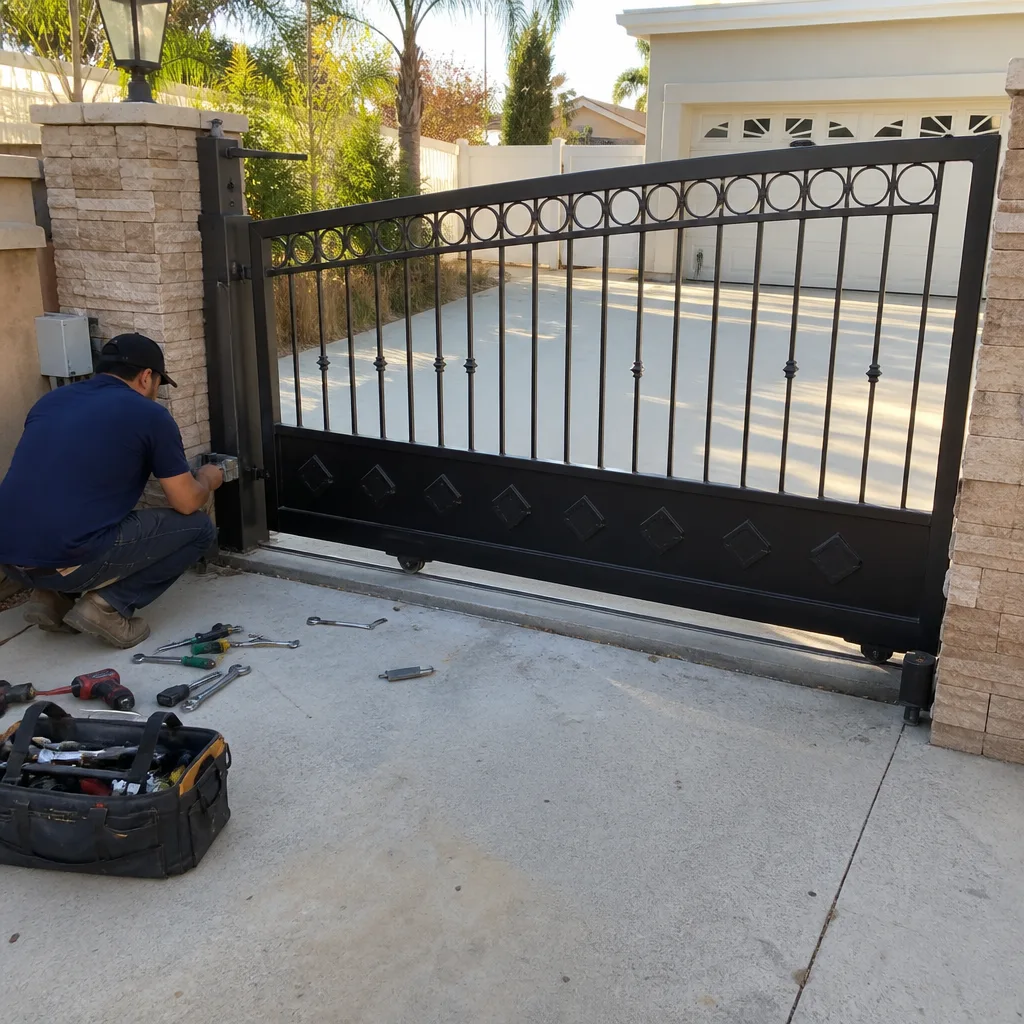 After
After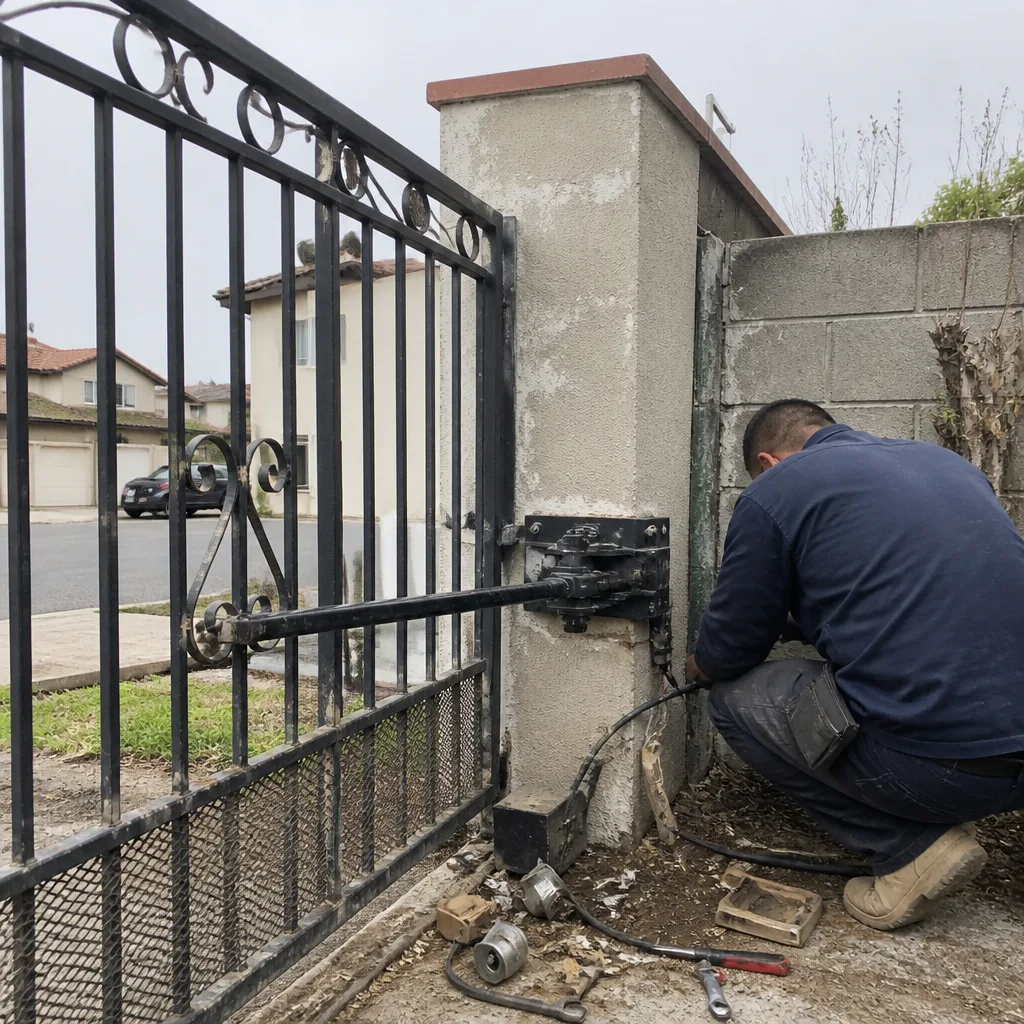 Before
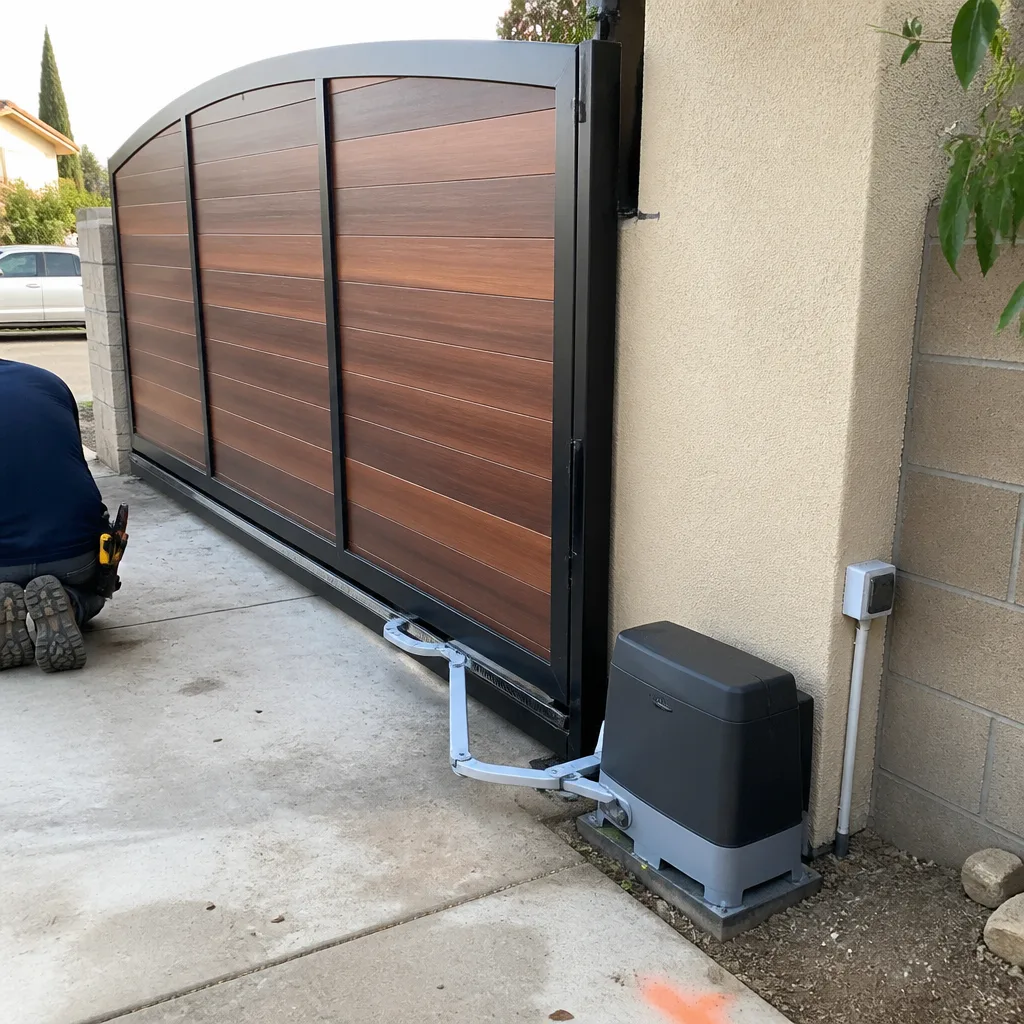 After
After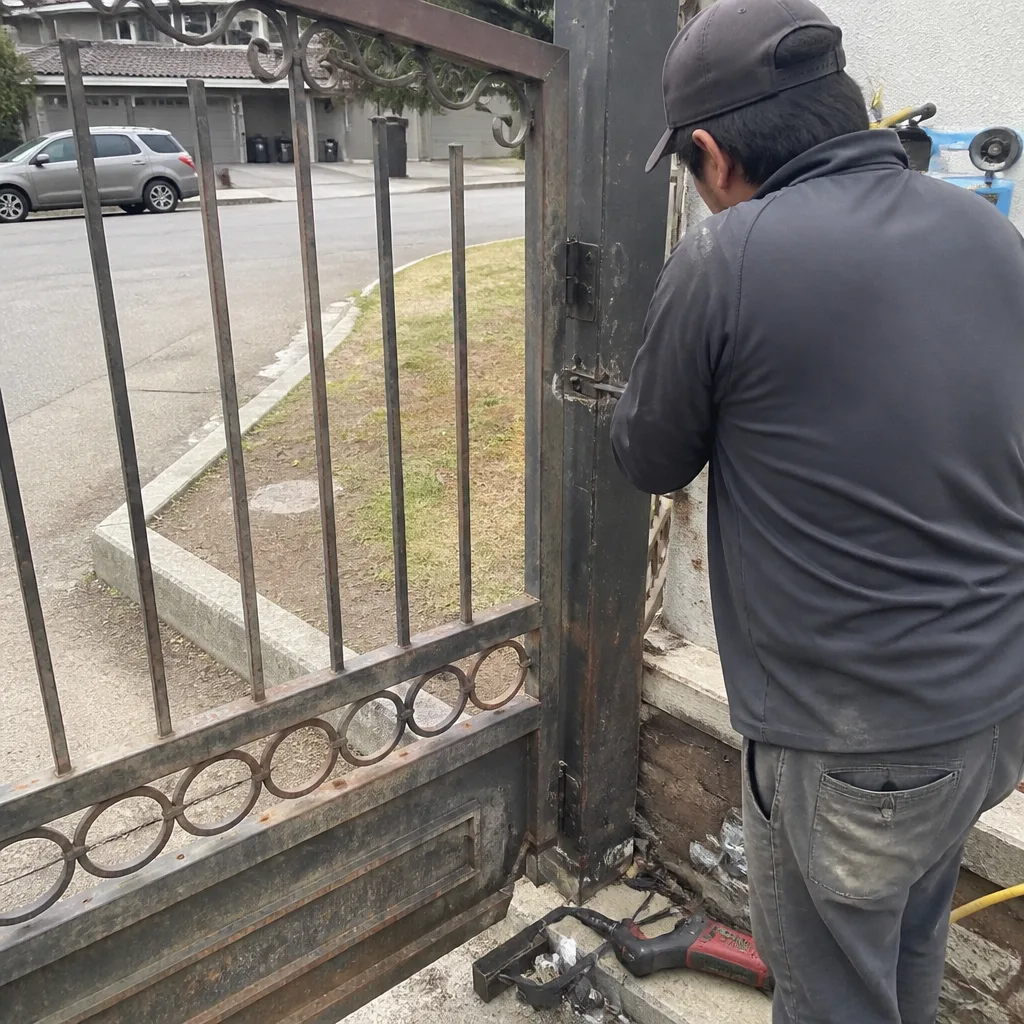 Before
 After
AfterGate Repair Maintenance Checklist for Rancho Cucamonga Homeowners
Most maintenance checklists for driveway gates are written like someone read the back of a lubricant can and stopped there. They tell you to grease the chain. They don’t tell you that a correctly serviced gate chain in Rancho Cucamonga should look damp, not wet, and that a heavy coat of grease isn’t protection. It’s a magnet for the fine granite dust that blows off the San Gabriel foothills year-round and especially during Santa Ana season. That dust mixes with excess lubricant and becomes an abrasive paste that accelerates chain and sprocket wear faster than running the gate dry. This guide fixes that problem. Every item below includes a specific pass/fail threshold so you can tell the difference between normal wear and a repair that is already overdue.
Quick Answer
A gate maintenance checklist for Rancho Cucamonga homeowners should cover seven measurable items each season: chain or belt tension, lubricant condition (dry, damp, or over-greased), hinge play, limit-switch travel, photocell alignment, battery voltage for solar or backup systems, and track or wheel condition. Each item below has a pass/fail threshold. If any item fails its threshold, schedule Gate Repair services before the next seasonal shift, especially before summer heat or Santa Ana winds.
Table of Contents
- Lubrication: What Dry, Correct, and Over-Lubricated Actually Look Like
- Reading Limit-Switch Positions Yourself: The Acceptable Travel Range
- The 30-Second Photocell Alignment Test Any Homeowner Can Perform
- The Seasonal Timing Map for Rancho Cucamonga: April vs. November Checks
- Creating a Maintenance Logbook a Future Technician Can Actually Use
- Battery Voltage and Solar Panel Checks
- Hinge, Roller, and Wheel Inspection Thresholds
- Common Mistakes to Avoid
- When to Call a Professional
- Frequently Asked Questions
BeforeAfterLubrication: What Dry, Correct, and Over-Lubricated Actually Look Like
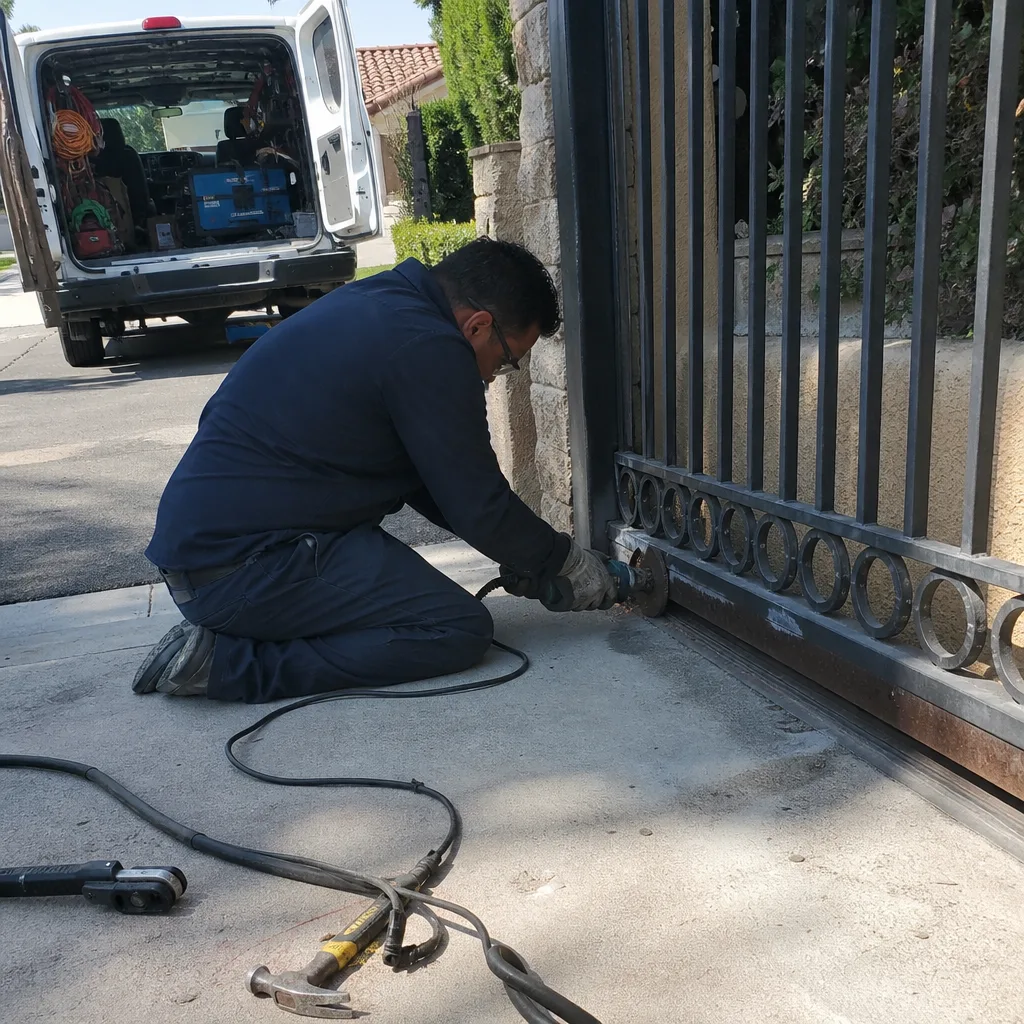
Lubrication is where most self-maintenance goes wrong in Rancho Cucamonga, and the failure is almost always too much product, not too little. We service gates across Rancho Cucamonga and the first thing we find on gates that have been “maintained” by a homeowner is a chain caked in a quarter-inch of dried grease mixed with granite dust. That is a wear accelerant, not a protectant.
The correct amount of lubricant depends on the component. Here are the thresholds:
- Chain (sliding gate): Wipe the chain clean with a dry rag first. Then apply white lithium grease in a thin bead along the inside rollers. The chain should look damp, not glossy. If you can run your finger along the chain and come away with a thick glob, you’ve over-lubricated. Pass: chain looks uniformly damp and moves without squeak. Fail: chain is bone-dry with visible surface rust, or chain is sticky with accumulated paste.
- Rack-and-pinion (sliding gate): This is the flat toothed bar along the bottom of the gate. Apply a 1/8-inch bead of white lithium to the pinion gear teeth only, then cycle the gate twice. Wipe off any that squishes out. Excess on a rack in Rancho Cucamonga is a fast path to grinding paste, because the rack sits close to the ground where dust accumulates.
- Hinges (swing gate): Each hinge takes one to two drops of 30-weight oil at the pivot pin. That’s it. Not a spray, not a soak. Drip it, cycle the gate, wipe the drip. Pass: no squeak and no visible rust bloom at the pin. Fail: squeak persists after oiling, or the hinge shows a fine red dust that indicates internal rust.
- Rollers and wheels (cantilever and V-track gates): Do not grease roller faces. Grease only the axle bearings if the roller has a grease fitting. Roller faces must stay dry to grip the track. If your V-track rollers are greased, the gate will slip and the motor will burn extra cycles.
- Belt (linear-style gates from LiftMaster or similar): Belts need no lubrication. If a belt squeaks, the tension is wrong or the belt is worn, not dry. Lubricating a belt accelerates cracking.
The granite dust issue is not theoretical. The San Gabriel foothills release fine mineral particulates year-round, and when the Santa Anas blow in from the northeast in October through January, that dust gets driven horizontally into gate mechanisms. A lightly lubricated chain sheds that dust. A heavily greased one absorbs it.
Reading Limit-Switch Positions Yourself: The Acceptable Travel Range
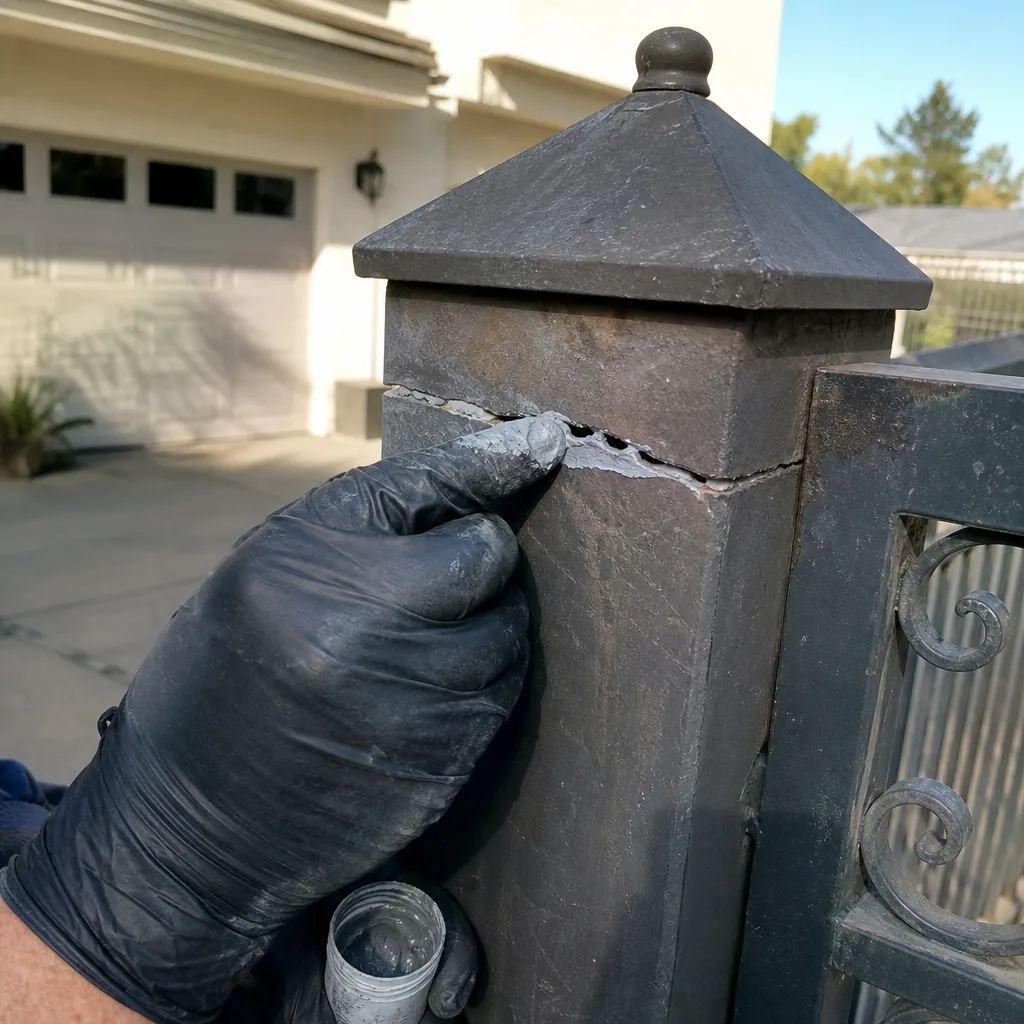
A limit switch is the device that tells the gate motor where the gate stops in the open and closed positions. On most residential swing and slide gates in Rancho Cucamonga, two limit switches are used: one for full open and one for full closed. When the gate slams into the stop at the end of travel, or when it stops six inches short of the closed post, the limit switch setting is the problem.
You can read your limit-switch positions without opening the control board. Here’s the step-by-step:
- Run the gate to full closed. Watch the gate leaf or panel as it stops. The correct closed position leaves the gate sitting against the stop post or end catch with firm contact, not bouncing back and not stopping with a visible gap.
- Measure the gap. If the gate stops with a gap of more than roughly one inch between the gate and the closed stop, the closed limit is set too early. If the gate drives into the stop and you hear the motor grunting for a beat before it cuts out, the closed limit is set too late and the operator is over-driving the gate against physical resistance.
- Run the gate to full open. On a slide gate, the gate should stop with the trailing edge clear of the driveway opening by at least six inches. If the gate stops with the trailing edge still partially across the opening, the open limit is set too early and the gate hasn’t fully cleared the drive. If the gate slams into the physical end stop, the open limit is set too late.
- Watch for bounce. After the motor stops, the gate should settle once and stay. If the gate bounces back two or three inches, the limit is cutting power while the gate still has momentum. That bounce puts repeated force on the rack or arm and shortens motor life.
On most modern operators from brands like DoorKing, Elite, Mighty Mule, or LiftMaster, limit positions are set with cams or with digital programming at the control board. On older mechanical-limit units, the limit nuts travel on a threaded shaft and tighten or loosen over time. If your limit is off by more than an inch at either end of travel, or if the gate bounces, a technician should recalibrate the limit. A limit that’s wrong by a small amount is an adjustment. A limit that keeps drifting is a sign of a worn cam, a failing magnetic sensor, or a motor coupling that’s starting to slip.
In our experience, a gate that stops short in Rancho Cucamonga is usually a closed-limit issue, not a motor problem. The fix is often a fifteen-minute adjustment, not a replacement. That’s exactly the kind of thing that should be checked before anyone quotes you a new operator.
If you’re diagnosing a limit issue and want a documented second set of eyes, our gate motor and opener service in Rancho Cucamonga includes a written record of every limit reading before and after adjustment.
The 30-Second Photocell Alignment Test Any Homeowner Can Perform
A photocell, also called a photo-eye, is the infrared beam that runs across the gate opening at roughly ankle height. If the beam is broken while the gate is closing, the gate should reverse. Most residential gate systems in Rancho Cucamonga use a pair of photocells: one sends, one receives. If the beam is misaligned, the gate will refuse to close, or it will close only when you hold the button, or it will reverse for no reason.
Here’s the 30-second alignment test that requires no tools:
- Check the indicator light first. Most photo-eyes have a small LED on the receiving unit. A steady light means the beam is received. A blinking light or no light means the beam is not reaching the receiver.
- Wave your hand through the beam. When the gate is open and stationary, pass your hand vertically through the beam path. You should see the LED on the receiving unit flicker or blink once. That flicker means the beam is live and the receiver is recognizing interruption.
- Look at the beam alignment physically. Crouch behind the sending eye and sight down the beam toward the receiving eye. The two units should be aimed roughly at each other. A gap of more than a quarter-inch of visible misalignment at ten feet is enough to break the beam connection, especially on bright days when ambient sunlight confuses the receiver.
- Cycle the gate closed. Place a lightweight object like a cardboard box across the beam path and hit the close command. The gate should stop and reverse or hold. If the gate closes through the box, the photocell is either misaligned, wired incorrectly, or bypassed.
Misalignment readings on a multimeter versus by observation: if you test the photo-eye circuit with a multimeter on the control board, a properly aligned set typically shows around 0 to 1 volt DC at the receiver terminal when the beam is unbroken, and around 12 to 24 volts DC when the beam is interrupted, depending on the system. If you see 12 to 24 volts DC constantly at the receiver terminal, the beam is not making contact at all. That’s a confirmed misalignment or a failed sender. Observation should match: a receiver LED that won’t stay steady under any aiming angle usually means the sender’s infrared emitter has failed, not merely that the alignment is off.
Photocell problems are common in Rancho Cucamonga for a simple reason: the ground shifts slightly with seasonal moisture and heat, and a photocell mounted on a flimsy stake or a shifting post drifts a few degrees over a season. A photocell that was aligned in March may not be aligned in September. This is a thirty-second check you should run every quarter.
The Seasonal Timing Map for Rancho Cucamonga: April vs. November Checks
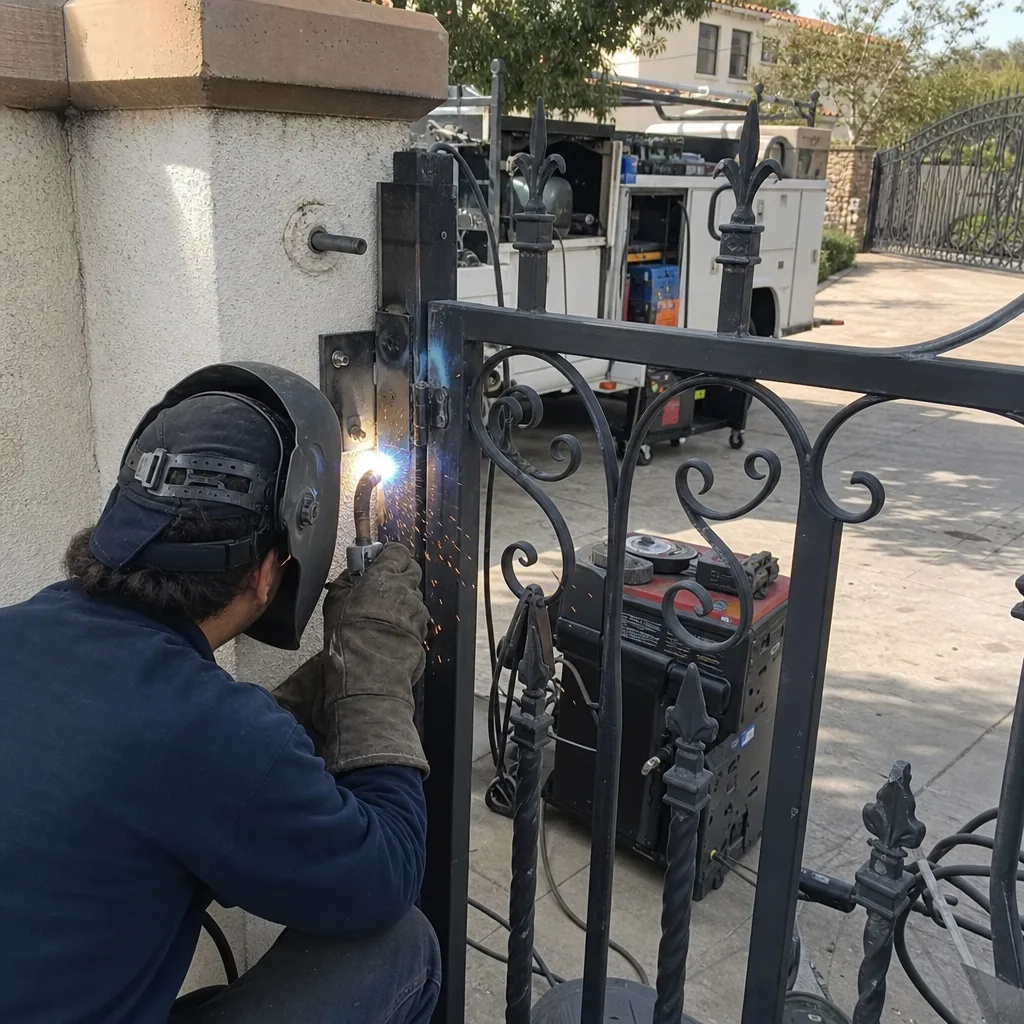
Rancho Cucamonga has two service seasons for gates, and they’re defined by weather patterns, not calendar dates. Here’s what to check in each window and why.
April: Pre-Summer Heat Checks
By April, daytime temperatures in Rancho Cucamonga regularly cross into the mid-80s, and the real heat arrives by June. Heat does two things to gate systems: it expands the metal, and it stresses the battery. Run these checks in April:
- Battery voltage. Heat shortens the life of lead-acid backup batteries. Test the battery under load (battery disconnected from the panel, voltmeter on the battery terminals). A healthy 12-volt battery should read 12.6 volts or higher sitting. If it reads 12.2 or lower, the battery is already sulfating and will likely fail during the summer’s peak demand.
- Chain tension. Metal expands in heat. A chain that’s tight in April will be looser in August. Set chain tension with about a half-inch of vertical deflection at the midpoint between sprockets. If it’s tighter than a quarter-inch of deflection, it’s over-tight and will stretch the chain and wear the motor bearing when temperatures climb.
- Solar panel output. If your gate runs on solar, clean the panel face with a damp cloth and check the charge controller reading in full sun. A panel that shows less than 14 volts open-circuit on a sunny April day is either dirty, shaded, or failing.
- Track and wheels. Heat expands the track sections, and joints that were smooth in winter can develop small lips that catch rollers. Run the gate manually and listen for a tick or bump at each track joint.
November: Pre-Santa Ana Wind Season Checks
Santa Ana winds in Rancho Cucamonga typically run from October through January, with the strongest gusts often arriving in November and December. These northeast winds do three things: they load swing gates with side pressure, they drive dust into every mechanism, and they knock branches and debris onto tracks. Run these checks in November:
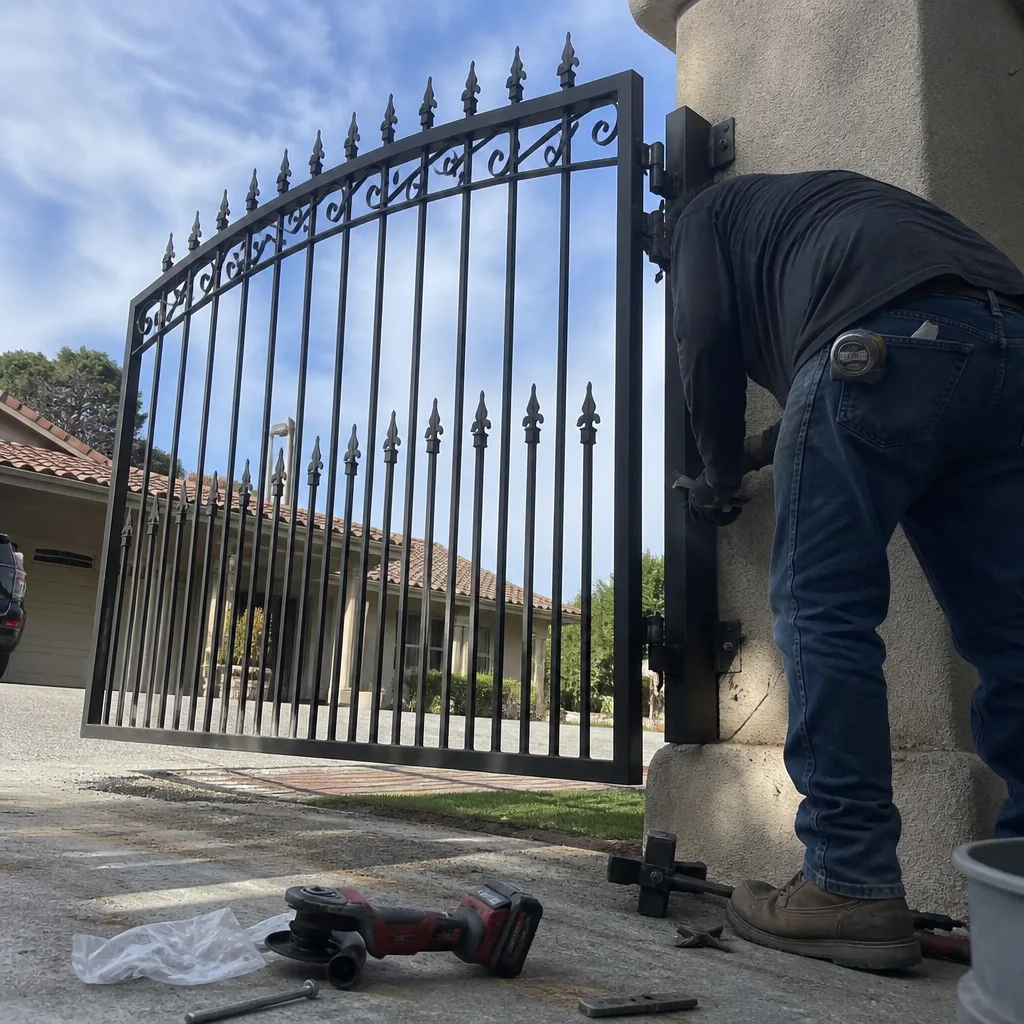
- Hinge wear on swing gates. Wind loads a swing gate laterally, which is the direction hinges are weakest in. Check each hinge for vertical play by lifting the gate leaf at the latch end with one hand. More than a quarter-inch of movement at the free end means a hinge pin or bushing is worn and will fail under repeated wind gusts.
- Photocell alignment. A photocell on a post that flexes in wind will drift. Run the 30-second alignment test in November and again in January.
- Debris removal from tracks and V-rails. Santa Anas blow leaves, palm fronds, and gravel into slide gate tracks. Walk the full track and pull anything larger than a pencil eraser out of the V-rail or flat track.
- Rack and pinion lubrication. Dust load increases dramatically during wind season. Wipe the rack clean and apply the 1/8-inch bead before the dust season is in full force. A clean rack sheds dust; a greasy one holds it.
- Gate catch and drop-bolt alignment. Wind pushes swing gates out of alignment slightly. Close the gate and confirm the drop bolt or latch seats fully into the catch without you having to muscle the gate into position.
These two windows, April and November, cover about 90 percent of the seasonal failures we see on residential gates in Rancho Cucamonga. If you complete the full checklist in both windows, you’ll catch most problems before they become gate-stuck-at-midnight failures; for additional help, see our Gate Repair Warning Signs: A Rancho Cucamonga Homeowner’s Reference Guide.
Creating a Maintenance Logbook a Future Technician Can Actually Use
A maintenance logbook is a cheap tool that saves real money. The problem with most logbooks is that they record feelings, not measurements. Writing “gate seemed okay” is not useful to the next technician. Writing “closed limit stops 1.5 inches short of the stop post; tightened chain 1/4 turn on 11/3; photocell receiver LED steady” is a record a future technician can work from.
Here’s the format we recommend for each entry, and it’s the same format we use on every service visit at Vance Gate Repair Rancho Cucamonga home:
- Date and season. Note which window you’re in: April or November.
- What you checked. Just the list: chain tension, hinge play, limit travel, photocell, battery voltage, track condition.
- What you measured. Actual numbers. “Chain deflection: 1/2 inch at center span.” “Battery: 12.7 volts.” “Closed limit gap: 0 inches.”
- What you adjusted. “Added white lithium to chain, wiped excess.” “Tightened left hinge nut 1/4 turn.”
- What you left alone and why. “Right hinge shows no vertical play. No action.”
- Photo. One picture of the gate in the open position and one of the mechanism area. Store them in the same folder as the logbook.
That’s it. A logbook entry takes five minutes per quarter. When a future technician shows up, they don’t start from zero. They see the gate’s recent history, the last measurements, and the last adjustments. That means faster diagnosis and a smaller bill, because the technician isn’t spending the first hour reverse-engineering what was done. We file a written record and photo log on every job we complete in Rancho Cucamonga, and a homeowner’s logbook works the same way. For more guides & resources, visit our blog.
Battery Voltage and Solar Panel Checks
Standby and solar batteries are the least-checked component on residential gates, and in Rancho Cucamonga’s heat, they’re also among the most likely to fail. A gate battery that works fine at 5 p.m. may drop below the minimum required voltage at 3 a.m. after a full day of charging and a night of standing.
Here’s the checklist, with thresholds:
- Locate the battery. On most residential operators from Mighty Mule, Ghost Controls, or similar brands, the battery is in a small weatherproof box near the operator. On solar systems, the battery is often in a vented enclosure.
- Check the date code. Lead-acid and AGM gate batteries last roughly 2 to 4 years in Rancho Cucamonga heat. If the battery is older than 4 years and hasn’t been load-tested, it’s due for replacement regardless of voltage reading.
- Read the resting voltage. Disconnect one battery cable and measure voltage across the terminals. A healthy, fully charged 12-volt AGM battery reads 12.6 to 12.8 volts. A reading of 12.2 to 12.5 means the battery is partially discharged or starting to sulfate. A reading below 12.0 volts under no load means the battery is failing.
- Read the charging voltage. Reconnect the battery and measure at the terminals while the operator is plugged in or the solar panel is in full sun. The charging voltage should read between 13.5 and 14.5 volts. If the charging voltage is below 13 volts, the charger or solar controller isn’t delivering full charge. If it’s above 15 volts, the charger is over-charging and cooking the battery.
- Do a load test, if you can. Trigger the gate open while watching the voltmeter. Voltage should not sag below 11.5 volts during operation. If it dips to 11 or below, the battery cannot hold voltage under load and will fail soon.
Solar panel checks are straightforward. Inspect the panel for cracks in the glass or delamination around the frame. Clean the face with water and a non-abrasive cloth. Check that the panel’s angle still faces roughly south. And most importantly, note anything that now casts shade on the panel that wasn’t there when it was installed, like a tree that’s grown or a new fence section. A solar panel that spends half the day in partial shade in Rancho Cucamonga may drop below the charging threshold and never recover the battery.
Hinge, Roller, and Wheel Inspection Thresholds
Hinges and rollers are load-bearing components, and they wear mechanically. The thresholds are physical movement measurements.
Swing Gate Hinges
- Pass: Lift the gate at the free end. Total vertical movement at the latch end is less than 1/4 inch. No visible gaps between hinge pin and bushing.
- Fail: Free-end vertical movement exceeds 1/4 inch, or you can see a visible gap at the hinge bushing, or the hinge makes a clunk when the gate reverses direction.
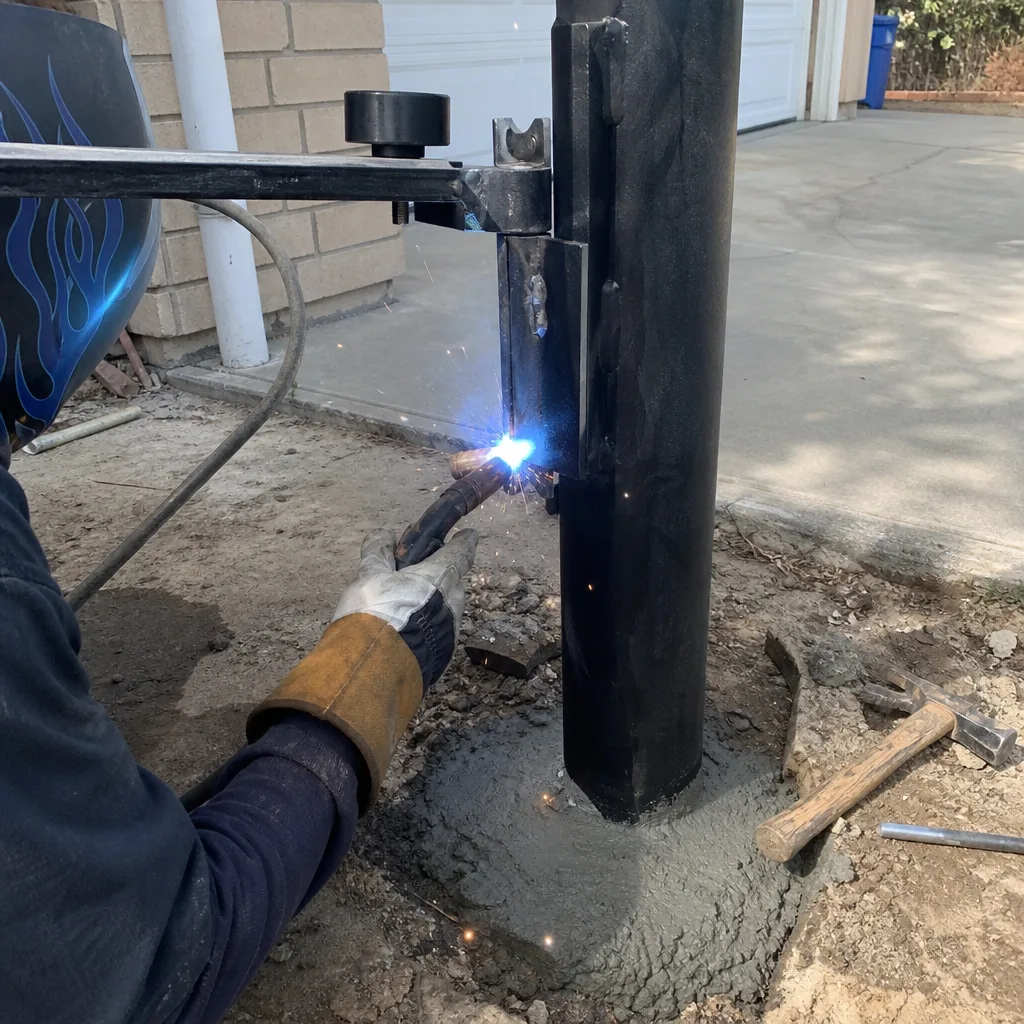
- Fail: Any hinge weld shows a crack. Weld cracks are a structural failure in progress, not a maintenance item.
Cantilever Gate Rollers
- Pass: Rollers spin freely when the gate is rolled manually. No flat spots on the roller face. Roller brackets show no deformation.
- Fail: A roller that skids instead of spinning, or a roller with a visible flat spot, or a bracket that flexes more than 1/8 inch when the gate is rocked side to side.
V-Track Gate Wheels
- Pass: Gate rolls smoothly the full length of travel with a consistent resistance. Wheel bearings make no grinding noise.
- Fail: A rhythmic bump every wheel rotation indicates a flat spot or a bearing failure. A grinding or clicking noise from the wheel area under gate movement is an immediate maintenance stop.
If a hinge, roller, or wheel fails any of these thresholds, stop using the gate and call a technician. Operating a gate on a worn roller punches additional load back through the gearbox and motor, and the repair bill climbs fast. A $60 roller replaced today prevents a $600 gearbox rebuild in six months. For a complete evaluation of gate hardware, including rollers, hinges, and welding repairs, see our gate repair services in Rancho Cucamonga.
Common Mistakes to Avoid
- Over-lubricating the chain or rack. In Rancho Cucamonga, dust from the San Gabriel foothills sticks to heavy grease and creates grinding paste. A damp chain is a protected chain. A greasy one is a wear problem in progress.
- Lubricating belts. Belt-driven gates, including many LiftMaster residential operators, use belts that require no lubrication. Spraying a belt with any lubricant accelerates cracking and belt failure.
- Ignoring a half-inch limit gap. A gate that stops an inch short of closed looks fine until the wind catches it or a small animal gets through. The limit switch, not the gate leaf, is the fix, and it’s a cheap one.
- Greasing V-track wheels. V-track wheels need dry contact with the track to grip. Greasing them causes the gate to slip, which forces the motor to work harder and shortens its life.
- Treating a dead battery as a motor problem. A gate that runs fine on AC but won’t move on backup battery has a battery problem, not a motor problem. Test the battery before replacing anything else.
- Skipping the November wind-season check. Santa Ana winds in Rancho Cucamonga are a known seasonal event, not a surprise. Hinges that were marginal in September will show visible wear by December. Catch it in November.
- Keeping no written record. A logbook costs nothing and saves real money. A future technician who can see the gate’s recent history diagnoses faster, and you pay less for the diagnosis.
When to Call a Professional
Call a professional when the gate fails any threshold on this checklist: weld cracks, hinge movement over 1/4 inch, battery voltage below 12.2 resting, limit drift that recurs after adjustment, or a photocell that won’t hold alignment. Also call if the gate ever reverses with no obstruction, or if you smell burning plastic from the operator. Do not attempt spring, cable, or high-tension repair yourself. These components carry stored mechanical energy and can cause serious injury when released improperly. A trained technician has the tools and the procedure to release and replace them safely. Vance Gate Repair Rancho Cucamonga offers free estimates on all gate repairs in Rancho Cucamonga. Call (909) 764-3720. A written price is provided before any work starts, and every visit includes a documented photo record.
Frequently Asked Questions
A basic preventive maintenance visit in Rancho Cucamonga typically runs between $89 and $149 when the gate is functioning and the visit is limited to inspection, lubrication, and minor adjustments. Repairs beyond adjustment, such as hinge replacement or motor service, are quoted separately in writing before any work begins. Call (909) 764-3720 for a written maintenance quote for your specific gate.
Yes. For gate repair calls in Rancho Cucamonga, our technicians are usually on site the same day or next day, and common repairs like limit adjustments, hinge replacements, and photocell realignment are completed in a single visit. More involved repairs, like motor replacement or welding, may require scheduling. Call (909) 764-3720 and a live person will tell you what’s realistic for your specific issue.
If the gate leaf, hinges, rollers, and track are structurally sound, repair is almost always less expensive than replacement. The gate itself rarely fails as a unit. What fails are the moving parts: hinges, rollers, the motor, the control board, or the wiring. A professional inspection can tell you which component is failing and quote the repair. If the gate leaf is rusted through at the bottom rail or the posts are no longer plumb, replacement becomes the better financial decision. For new gate work, see our gate installation services in Rancho Cucamonga.
We service nine major gate-automation brands, including DoorKing, Elite, Mighty Mule, and LiftMaster. We work on whatever motor is already on the property and do not push replacement when a repair is the right call.
Yes. Every visit includes a written record and photo log of what was found, what was adjusted, and what was replaced. This is our standard practice for every residential gate we service in Rancho Cucamonga, and it means no future technician has to re-diagnose the same problem from scratch.
First, check whether debris has blown into the track or the photocell path. If the gate is mid-travel and won’t move, disconnect the operator using the manual release handle and move the gate by hand if it moves freely. If the gate resists manual movement, do not force it. Call a technician. Santa Ana winds in Rancho Cucamonga routinely blow limbs and debris into slide gate tracks and knock swing gate hinges out of alignment, and those are repairable conditions, not total failures. Before starting any work, check Gate Repair Permits, Codes & Inspections in CA: What You Need to Know to ensure compliance.
The Bottom Line
A maintenance checklist only has value when it gives you pass/fail thresholds. “Check the chain” is not a task; “measure 1/2 inch of deflection at the midpoint and confirm the chain looks damp, not greased” is a task. Run the full list in April before the heat and in November before the Santa Anas. Record measurements in a simple logbook. Replace or repair anything that fails a threshold before it strands the gate in a position where your home is exposed. When a repair is beyond the scope of maintenance, call (909) 764-3720 for a written estimate from a gate specialist who documents everything.
Written by Adrian Vance, Owner at Vance Gate Repair Rancho Cucamonga, serving Rancho Cucamonga since 2014.