
Last updated September 20, 2026
Free on-site gate assessment - hinges, posts, and your LiftMaster or Nice gate operator checked before anything is quoted
The assessment is free and the quote is the invoice.

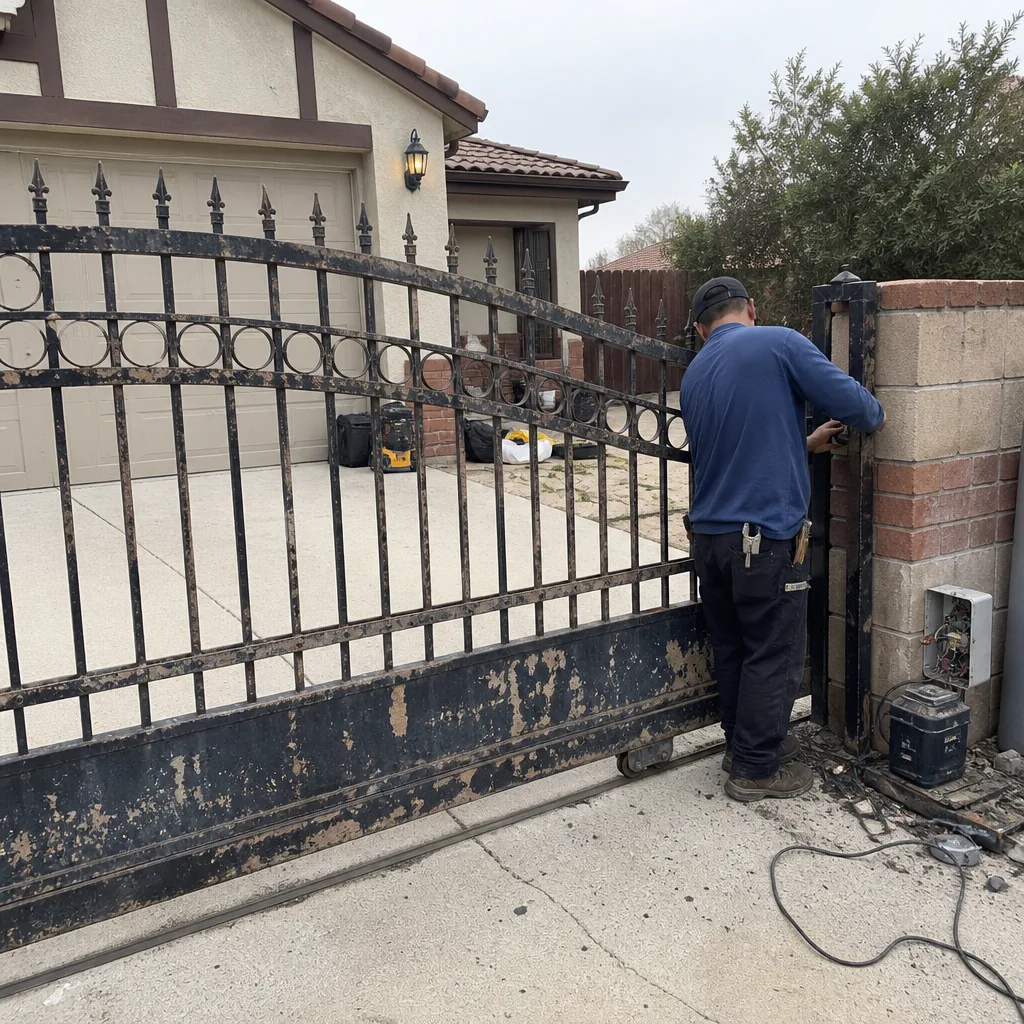 Before
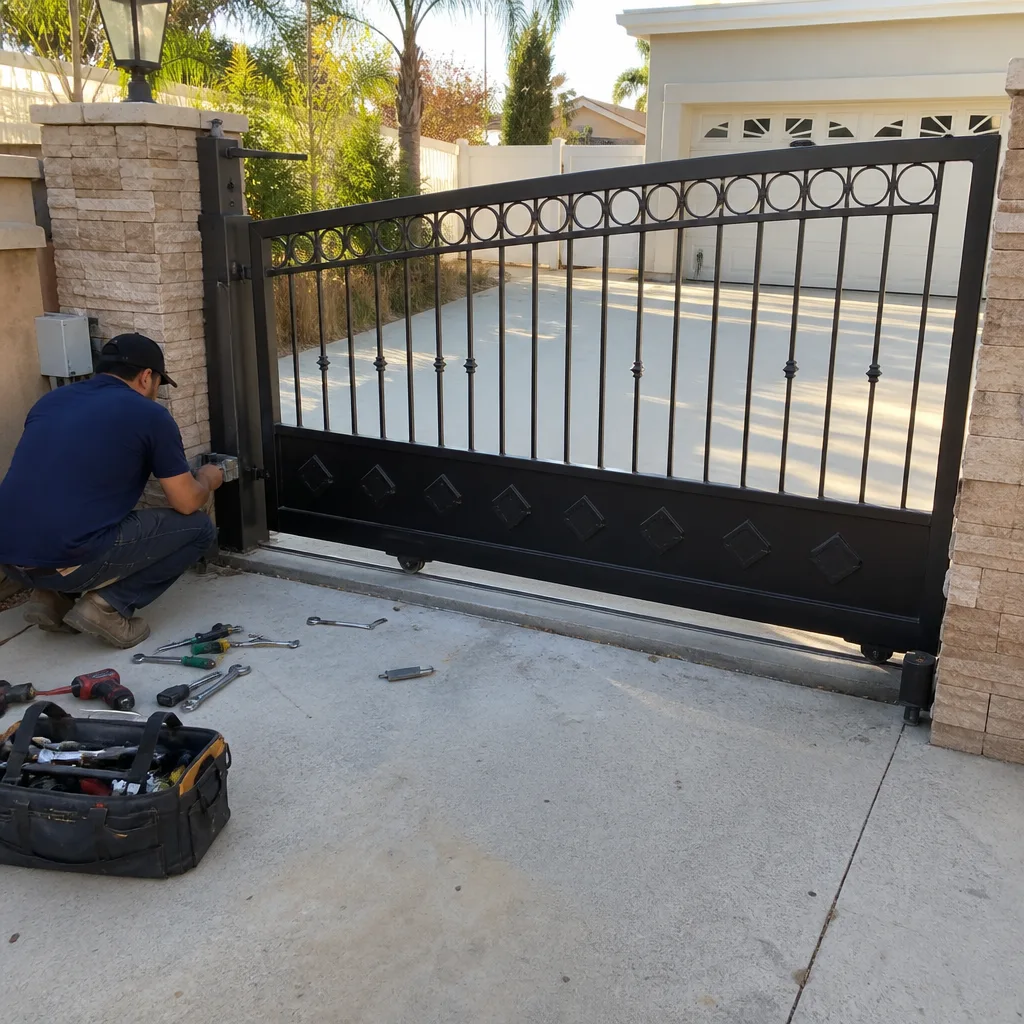 After
After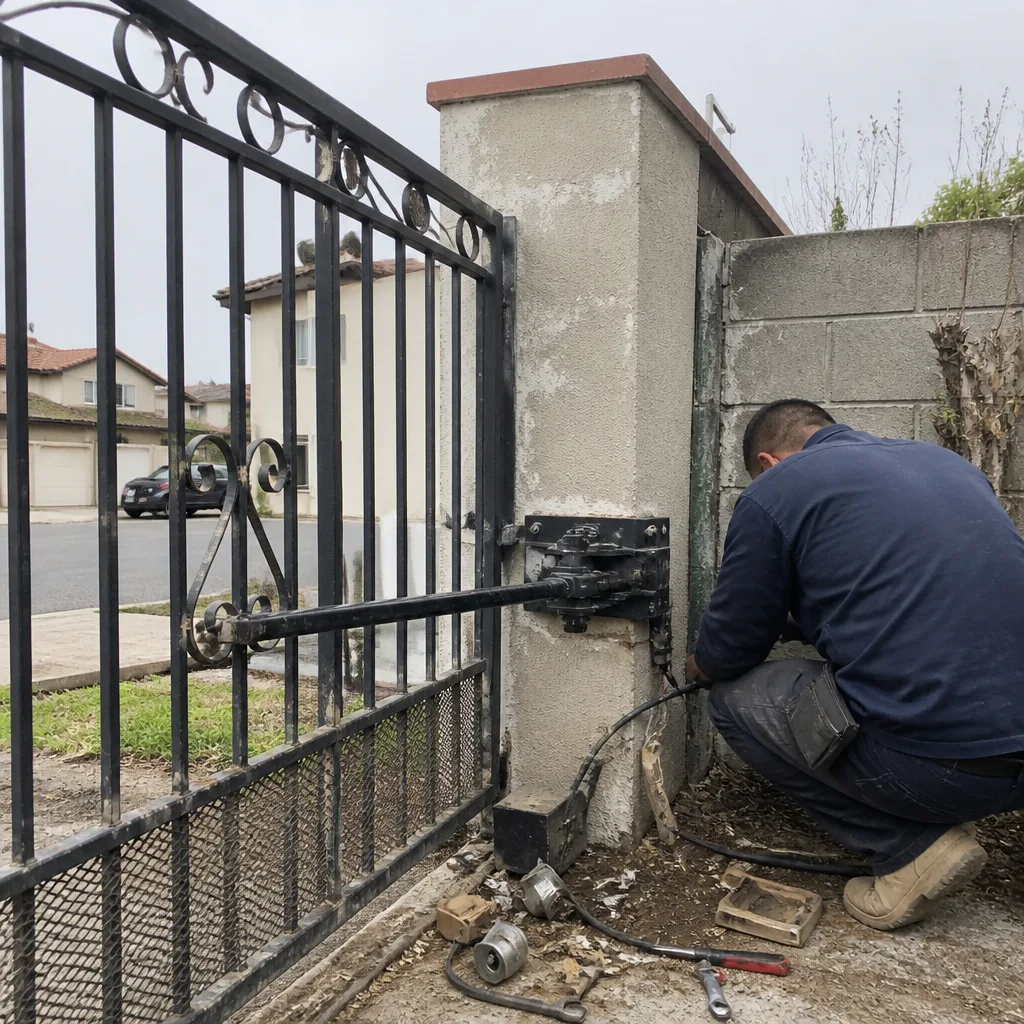 Before
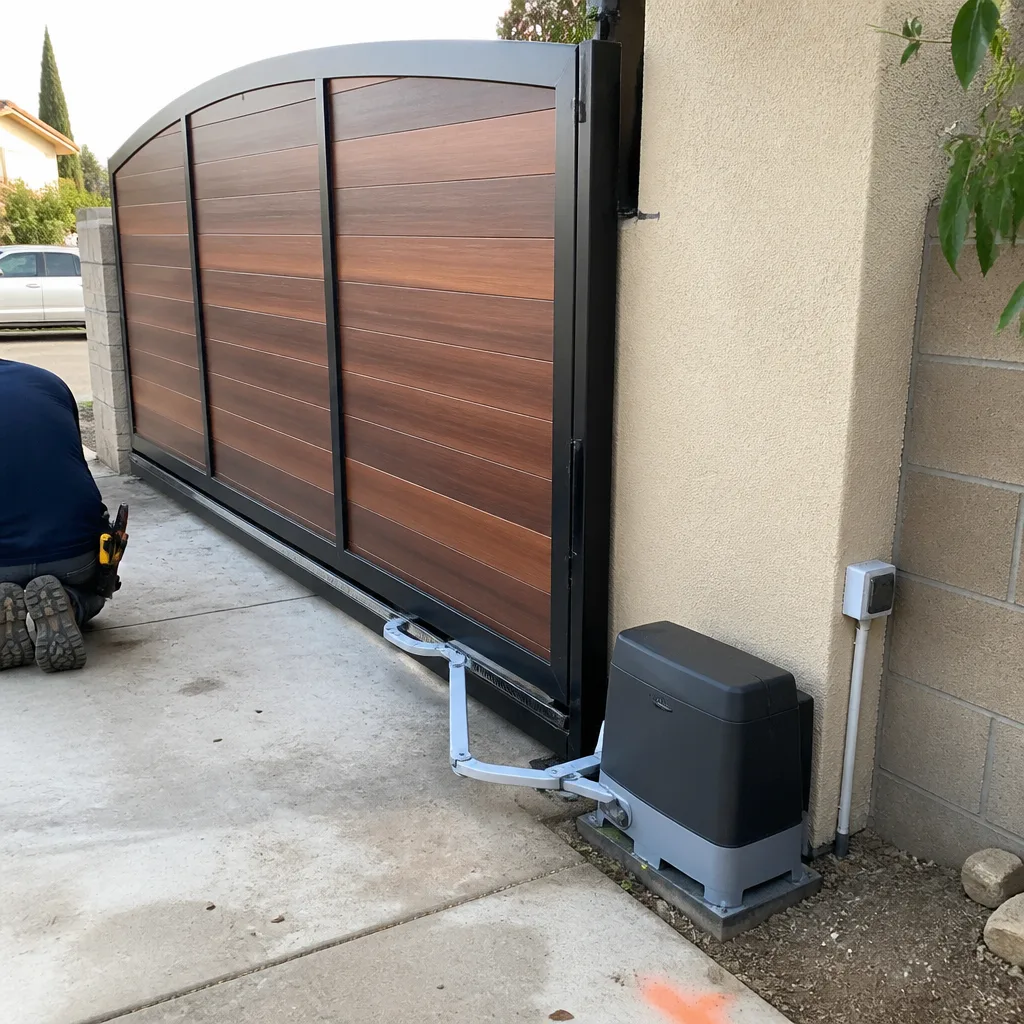 After
After Before
 After
AfterDIY vs Professional Gate Repair: The Rancho Cucamonga Homeowner’s Decision Guide
Replacing a gate remote battery is DIY. Replacing a photocell is mostly DIY. Adjusting a limit switch is DIY with a manual. Replacing a control board is professional work, not because it’s hard, but because it requires a wiring diagram to reconnect correctly. If you don’t document what you disconnect, the next failure costs more to diagnose than the board cost to install. This guide walks through the real decision points for gate repair in Rancho Cucamonga, where summer heat reaches 105°F and gate motors fail in predictable, specific ways. You’ll learn which repairs create cascading failure risk, when California electrical code pulls DIY work into permit territory, and which three repairs should never be attempted regardless of confidence level.
Quick Answer
Most surface-level gate repairs are safe DIY territory: remote batteries, cleaning photo-eye lenses, tightening visible bolts, lubricating hinges. The line moves to professional work when the repair touches wiring, automation components, or anything structural bearing the gate’s weight. In Rancho Cucamonga, where gate systems run daily in high-heat conditions, undocumented DIY electrical work is the leading cause of repair costs that double on the second visit. If the repair requires disconnecting more than two wires or removing any load-bearing component, call a professional.
Table of Contents
- The Task-by-Task Decision Matrix
- The Documentation Problem: Why Undocumented DIY Costs More Later
- California Liability: When DIY Gate Electrical Becomes an Insurance Problem
- Parts Sourcing Reality in Rancho Cucamonga
- The Three Repairs That Should Never Be DIY
- What You Can Safely Do Yourself
- Understanding Your Gate’s Subsystems Before You Touch Anything
- Common Mistakes to Avoid
- When to Call a Professional
- Frequently Asked Questions
- The Bottom Line
BeforeAfterThe Task-by-Task Decision Matrix
The DIY versus professional question in Rancho Cucamonga isn’t about skill level. It’s about whether the repair touches a system with cascading failure risk. Most homeowners make the wrong call because they’re thinking about the symptom they can see rather than the subsystem it lives in. A gate that won’t open could be a dead battery in the remote, a misaligned photo-eye, a failed capacitor, or a control board that received a power surge. The visible symptom is identical. The repair paths diverge significantly.
Here’s how we sort repairs at Vance Gate Repair Rancho Cucamonga home. The categories below are organized by documentation required and cascading risk, not difficulty alone.
Tier 1: Safe DIY, No Documentation Needed
- Remote battery replacement: Open the case, swap the battery, test. If it works, no documentation needed. If it doesn’t, the problem was never the battery.
- Photo-eye lens cleaning: Dust and spider webs build up on the infrared beam lenses, especially during Rancho Cucamonga’s dry, dusty summers. A soft cloth and glass cleaner fix this in 60 seconds.
- Visible bolt tightening: Gate hinges, arm brackets, and track bolts vibrate loose over time. A torque check on accessible hardware is genuinely useful maintenance.
- Track cleaning for slide gates: Pebbles, leaf debris, and dirt accumulate in the V-track. Clearing it by hand (gate disengaged) prevents roller wear.
Tier 2: DIY Possible, But Document Everything
- Limit switch adjustment: You can adjust limit switches with a screwdriver and the manual. But before you turn anything, photograph the exact position of every adjustment screw from three angles. The number-one second-opinion cost driver is a limit switch that was adjusted without recording where it started.
- Photo-eye replacement: If you can match the part number exactly and the mounting bracket is intact, this is doable. Photograph the wiring before disconnecting anything. Two wires, one photo, done.
- Remote reprogramming: Most remotes reprogram in under two minutes once you locate the learn button on the operator. The manual is essential. Photograph the board before pressing anything.
Tier 3: Professional Work, Regardless of Confidence
- Control board replacement: A control board has 12 to 20 terminals, and the wiring diagram matters more than the mechanical installation. Undocumented board swaps are the most common reason a second repair costs more than the first.
- Capacitor replacement: Capacitors store charge even when power is off. A charged capacitor can deliver a serious shock. Discharge procedures must be followed exactly.
- Underground loop wire repair: Induction loops for vehicle detection are buried in the driveway. Repair requires cutting concrete or asphalt, splicing in conduit, and re-sealing to a specific depth. The failure mode when done wrong is the loop failing again within months.
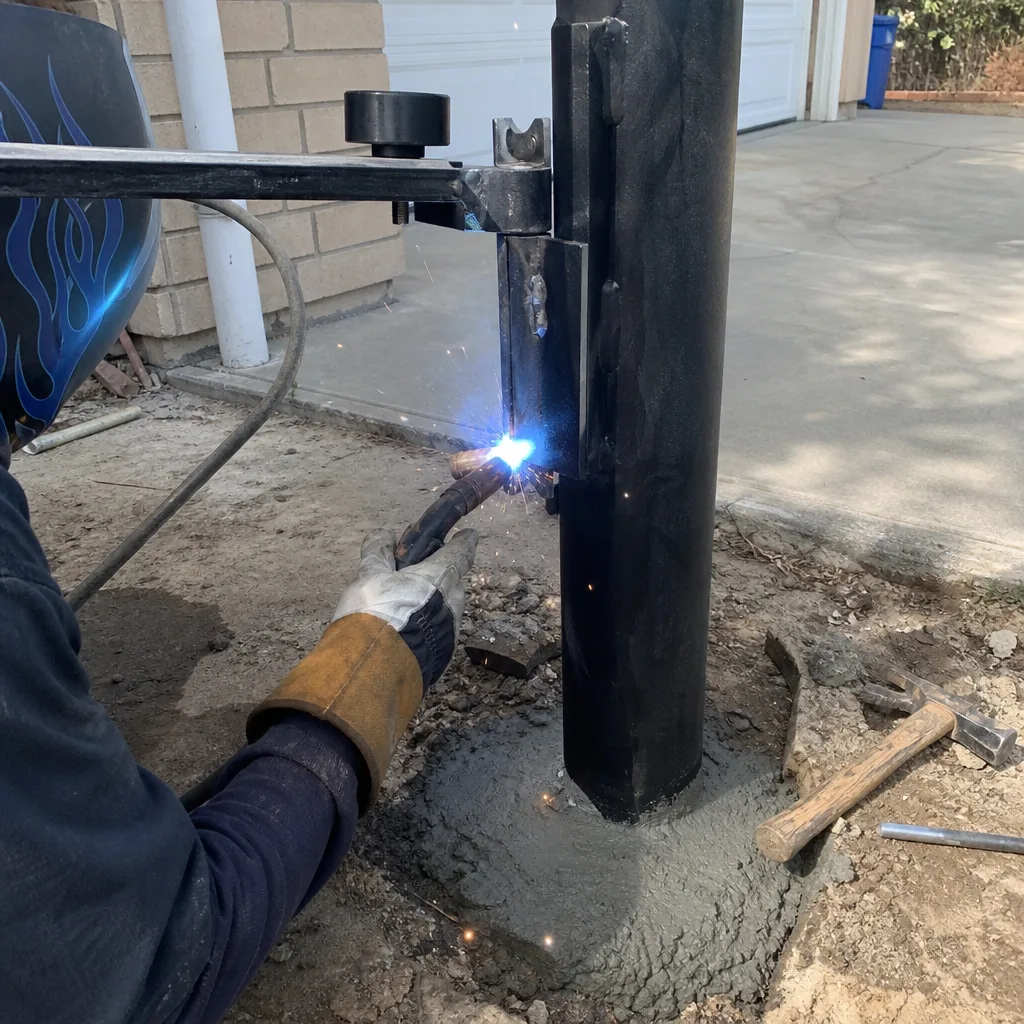
- Gate post anchoring: A gate post that has shifted means the concrete footing is compromised. The fix requires removal, re-pouring, and curing time measured in days. The gate must be removed and supported meanwhile.
- Operator mounting on swing gate arms: Mounting an operator arm in the wrong position creates uneven torque on the gate leaf. The gate will bind, the motor will strain, and the operator will fail early.
For repairs outside the scope of a confident DIY fix, Gate Repair in Rancho Cucamonga covers what professional repair looks like, including written pricing before work starts.
The Documentation Problem: Why Undocumented DIY Costs More Later
The most common reason a second-opinion technician charges more on a gate repair in Rancho Cucamonga isn’t that the first repair was done poorly. It’s that the first repair was done without leaving a record. Here’s the sequence we see regularly:
- A homeowner replaces a control board on a Viking operator himself. It works. The gate opens and closes. He saved the service call fee.
- Eight months later, the gate intermittently fails. A technician arrives and faces a board with wires connected in a configuration that doesn’t match the manufacturer’s diagram.
- The technician now has two options: guess at the original wiring configuration (risky) or trace every wire individually to determine what goes where (time-consuming).
- The diagnostic time doubles or triples. The homeowner pays more on the second visit than a professional board swap would have cost in the first place.
The lesson isn’t “don’t work on your own gate.” It’s “document what you disconnect.” The documentation habit is what separates a repair that ages well from one that boomerangs. In commercial access-control work, every wire movement is logged, photographed, and filed with the job record. Since 2014, Adrian Vance has applied that same standard to residential work through The Haven Standard. Clause 4 states: evidence on every job. Before we leave, you get a photo log of every adjustment and a written record of the part number installed.
If you’re doing Tier 2 DIY work, borrow that habit. Photograph before, after, and every step in between. Write down wire colors and terminal positions. If you don’t, the next technician’s first hour is spent reconstructing what you changed, and that hour is billed to you.
California Liability: When DIY Gate Electrical Becomes an Insurance Problem
California allows homeowners to perform electrical work on their own property under a broad owner-builder exemption in most residential contexts. This exemption covers replacing a gate operator or running low-voltage wiring for a photo-eye. But the exemption has limits that matter for Rancho Cucamonga homeowners.
First, the owner-builder exemption does not create a permit waiver when the work involves new electrical circuits. If you’re running 120V line voltage to a new gate operator location, that work requires a permit through the City of Rancho Cucamonga Building & Safety Department. Unpermitted line-voltage work discovered during a home sale or an insurance claim creates two problems: the work must be brought to code retroactively, and the insurance company may deny a claim if the unpermitted work is connected to the loss.
Second, the exemption applies to the homeowner’s own work. If you pay a neighbor or a handyman to do electrical work on your gate and that person is unlicensed, California law does not protect you the same way it would with a licensed contractor. The insurance gap is real: if the unpermitted, unlicensed electrical work causes a fire, a standard homeowner’s policy may deny the claim.
Low-voltage work (the 12V or 24V side of the gate system: photo-eyes, keypads, safety edges) rarely requires a permit. Line-voltage work (the 120V feed to the operator) often does. The distinction is straightforward but frequently ignored. If you’re touching wires connected to a standard electrical panel, that’s line voltage. If you’re touching wires that run between low-voltage components, that’s the safe side of the transformer.
The practical takeaway for Rancho Cucamonga homeowners: DIY on the low-voltage side is generally fine with documentation. DIY on the line-voltage side pulls you into permit territory, and the insurance implications of getting it wrong are not theoretical. They’re the difference between a claim paid and a claim denied.
Parts Sourcing Reality in Rancho Cucamonga
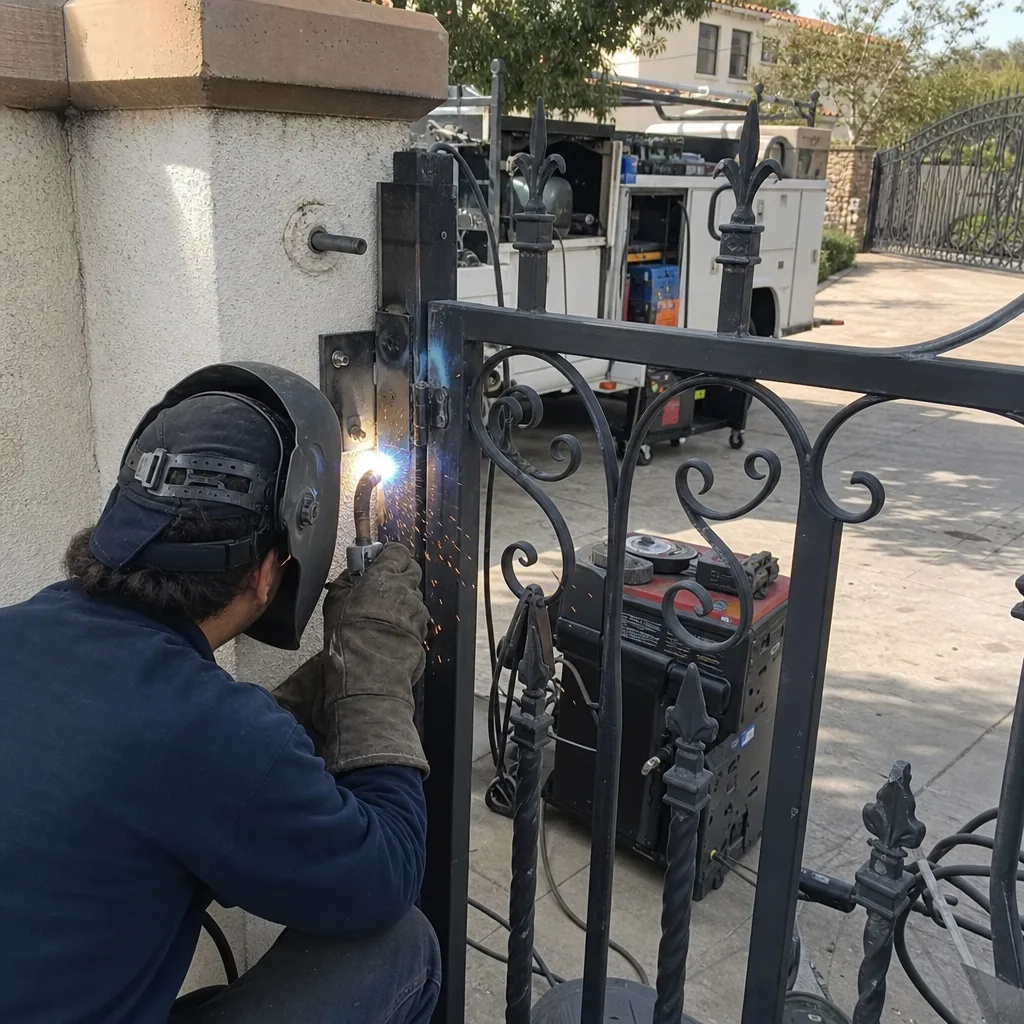
There’s a difference between what you can buy and what you can buy at a price that makes DIY worth it. Rancho Cucamonga has solid retail options for generic gate components: remotes, photo-eyes, batteries, hinges, and basic hardware are available at big-box stores and on Amazon. But the parts sourcing reality splits sharply when you move from generic components to brand-specific automation parts.
A replacement control board for a DoorKing or Elite operator isn’t sitting on a shelf at Home Depot. It’s available through wholesale distributors that typically require a contractor’s account, or on Amazon at a markup. Here’s what retail versus trade pricing looks like in practice:
| Component | Typical Retail Price (Amazon/Online) | Typical Trade Price (Contractor Wholesale) | Price Difference |
|---|---|---|---|
| Universal gate remote | $28-$45 | $22-$35 | 20-30% markup |
| Photo-eye (generic brand) | $45-$70 | $35-$50 | 25-40% markup |
| Control board (DoorKing, Viking, Elite, Ghost Controls) | $180-$350 | $140-$280 | 25-50% markup |
| Swing gate operator arm | $220-$400 | $180-$320 | 20-30% markup |
| Safety edge kit | $60-$100 | $45-$75 | 25-50% markup |
On a $25 remote, the Amazon markup is trivial. On a $300 control board, the markup is real but still modest compared to the labor that professional installation bills. The actual parts sourcing issue in Rancho Cucamonga isn’t price, it’s availability and fitment. A contractor that works across nine gate-automation brands has wholesale accounts that can source the exact part number the same week. A homeowner ordering online is often guessing at compatibility, and the return window on an electrical component closes fast once it’s been installed.
There’s also a subtle trap: Amazon listings often show “compatible with” rather than “genuine OEM.” A Ghost Controls operator runs on proprietary communication protocols between the board and the remote. A “compatible” knockoff remote sometimes works for a month, then fails because the rolling code protocol drifts. We’ve replaced enough knockoff remotes in Rancho Cucamonga to know that a $20 saving on a generic remote often becomes a $60 service call when the gate stops responding.
If you’re doing Tier 1 or Tier 2 work, source from the operator manufacturer directly or from a supplier that sells the genuine part number. If the part requires a wholesale account to source at a reasonable price, that’s a signal the repair is moving into professional territory. Gate Motor & Opener in Rancho Cucamonga covers motor-specific repair work and the parts that matter most.
The Three Repairs That Should Never Be DIY
There are exactly three gate repairs where confidence is irrelevant. The failure modes on these jobs are specific, severe, and expensive, and none of them announce themselves until weeks or months after the work was done. Homeowners attempting these repairs in Rancho Cucamonga are gambling with their gate’s structural integrity, their driveway’s electrical infrastructure, or both.
1. Underground Loop Wire
An underground induction loop detects when a vehicle is waiting at the gate. It’s a continuous loop of wire buried in the driveway, typically at a depth of 2-3 inches, encased in conduit or PVC, and sealed with sealant. When the loop fails, the gate doesn’t detect cars. The repair requires cutting the driveway or saw-cutting the asphalt, laying a new loop to a precise dimension (sensitivity depends on loop geometry), splicing the leads, and sealing the cut to prevent water infiltration.
Done wrong, the symptom is the same as the original failure: the gate doesn’t detect cars. But now the failure is intermittent, because water has infiltrated the splice and the loop reads false positives or false negatives depending on moisture levels. The homeowner paid for a repair that didn’t repair anything, and the second repair costs more because the previous loop must be removed and re-laid correctly.
2. Gate Post Anchoring
A swing gate hangs on its posts. Everything the gate does, every opening and closing, every wind gust, every daily cycle, loads onto the post and its concrete footing. When a post begins to lean or shift, the symptom is a gate that drags or binds at one end. The cause is a footing that is undersized, cracked, or deteriorating.
DIY fixes for a shifting post are almost always cosmetic: shimming the hinge, hammering the post back into position, adding brackets. None of these address the load path. The post is shifting because the concrete below grade is failing, and no amount of surface hardware fixes the structural problem. The professional fix is removing the gate, excavating the footing, re-pouring with proper depth and reinforcement, and allowing sufficient cure time before re-hanging the gate. In Rancho Cucamonga’s dry, compacted soil, this is a multi-day job. A homeowner who tries to shortcut it ends up with a gate that fails again within a year, and the second repair costs more because the structural damage has progressed.
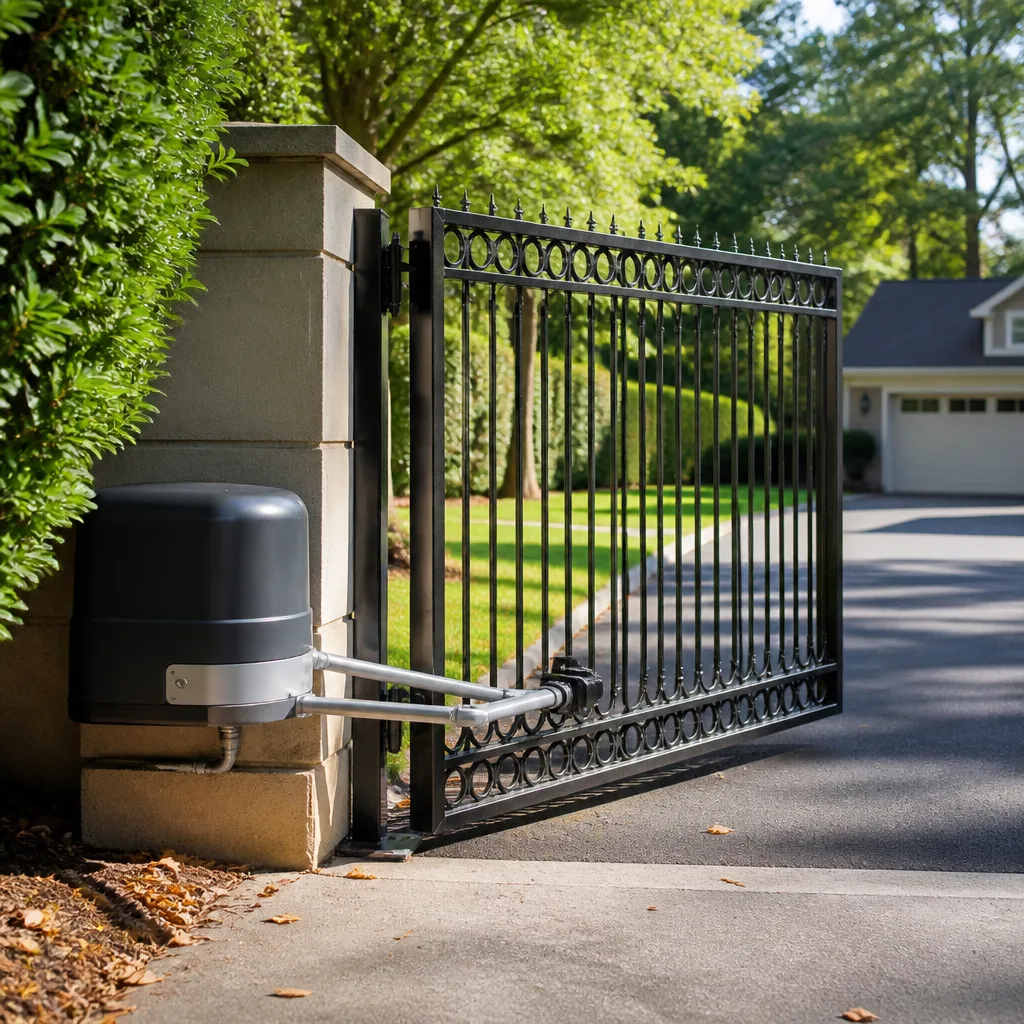
3. Operator Mounting on Swing Gate Arms
A swing gate operator arm translates rotational force from the motor into the linear movement that opens the gate. Mounting position matters: too close to the hinge and the gate moves slowly with reduced force; too far from the hinge and the gate binds, the motor strains, and the operator burns out early.
Placing an operator arm in the wrong position creates a cascade: the gate still opens and closes, so the homeowner thinks the job was done correctly. But the motor is drawing excessive current under load, the capacitor is stressed beyond its rated cycle life, and the control board is processing stall conditions it wasn’t designed to handle. The failure arrives months later as a burned-out motor or a failed board, and the homeowner attributes it to a defective part rather than incorrect installation. This is the most common root cause of early operator failure we see in Rancho Cucamonga when a homeowner or a handyman without gate-specific experience did the mounting.
These three repairs share a pattern: visible symptom, invisible subsystem, delayed failure. The entire point is that you can’t tell if you did it wrong until it fails later. The logical response is to avoid the gamble entirely.
What You Can Safely Do Yourself
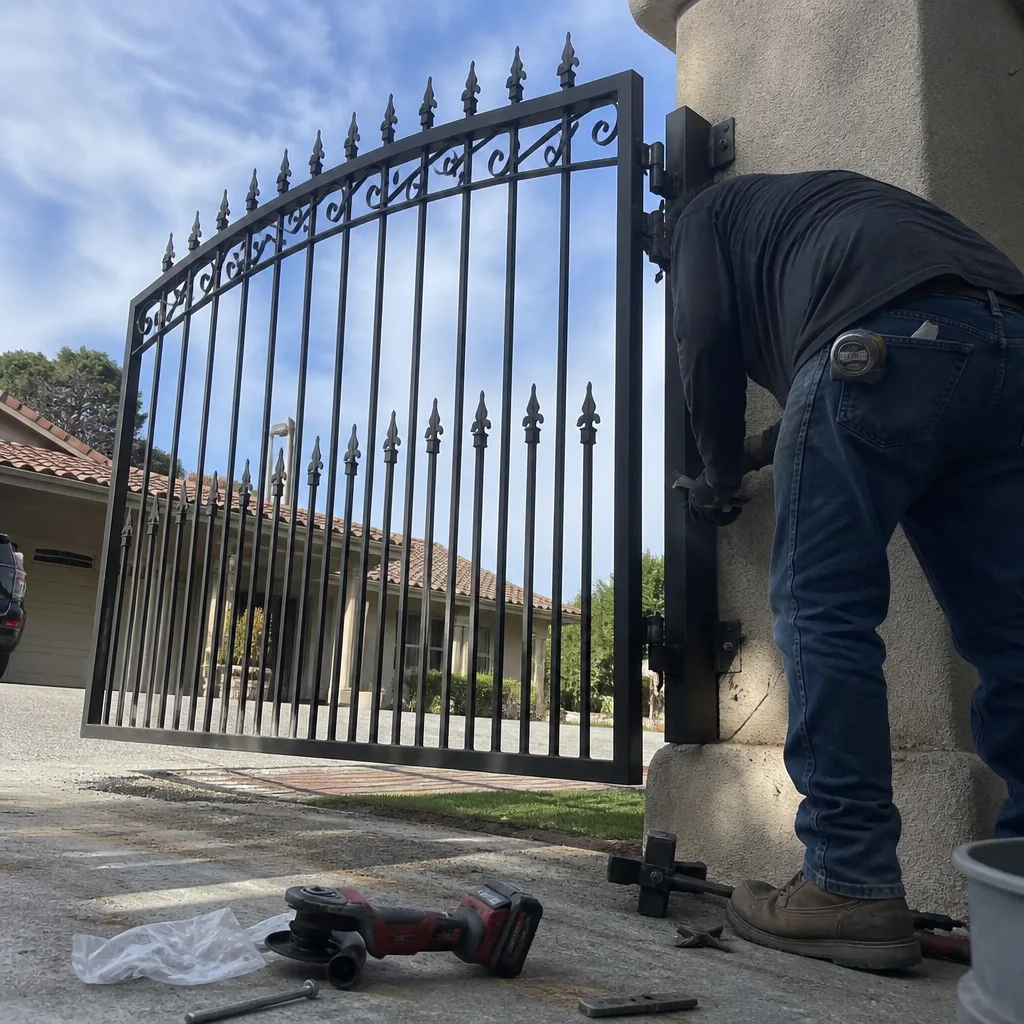
Not all gate work needs a professional. There’s a meaningful category of maintenance and minor repair that a Rancho Cucamonga homeowner can do correctly with basic tools and the operator’s manual. Here’s a practical list of what you can safely do yourself, with the caveats that matter, plus Gate Repair Maintenance Checklist for Rancho Cucamonga Homeowners for ongoing care.
Weekly or Monthly Maintenance
- Photo-eye cleaning: Dust accumulates fast during Santa Ana wind season. A dry microfiber cloth is sufficient. Avoid wet cleaning that leaves residue on the lens.
- Track clearing for slide gates: With the gate disengaged from the operator, sweep the track clear of debris. Pebbles and acorns are the usual culprits in Rancho Cucamonga yards.
- Hinge lubrication: Use a lithium-based grease, not WD-40. WD-40 displaces moisture but doesn’t leave a durable lubricating film. A few pumps per hinge, twice a year.
- Remote battery replacement: When the range on your remote drops, replace the battery before assuming the operator is failing. This is the most common false alarm in gate repair.
Seasonal Adjustments
- Limit adjustment when seasons change: Rancho Cucamonga’s temperature swings between winter and summer cause metal to expand and contract. A gate that closes fully in January might not seat in August. If you’re adjusting limits, photograph the starting position first, turn the screw one quarter-turn at a time, and photograph the ending position.
- Safety edge testing: You should test the safety edge monthly anyway. Block the gate’s closing path with a cardboard box. If the gate reverses, the edge works. If it doesn’t, disconnect power and call a professional. A non-working safety edge is a liability, not a maintenance issue.
These tasks are safe DIY work for a reason: none of them requires disconnecting more than two wires, none of them involves line voltage, and none of them has a delayed structural failure mode. If you stick to this list and keep your adjustments photographed and documented, your gate will age better than 80% of the gates we see on our first visit.
When the repair scope exceeds this list, that’s when you need Gate Installation in Rancho Cucamonga or a repair specialist. The line between safe and risky isn’t about your skill; it’s about the failure mode of what you’re touching.
Understanding Your Gate’s Subsystems Before You Touch Anything
Most DIY gate repairs go wrong because the homeowner treats the gate as a single machine. It isn’t. A residential gate in Rancho Cucamonga is a system of four independent subsystems that interact. A problem in one subsystem often presents as a symptom in another. Understanding the architecture before you touch anything is the cheapest diagnostic tool you own.
Subsystem 1: Mechanical Structure
The gate leaf, hinges, posts, track (for slide gates), and wheels. This is the heaviest subsystem and the one that determines everything else. If the mechanical structure is misaligned, the operator works harder, the control board runs hotter, and the safety edges trigger falsely. Mechanical problems are almost always professional work because they involve load-bearing components and structural repair.
Subsystem 2: Operator and Drive
The motor, gearbox, capacitor, and arm that physically moves the gate. Operators for swing gates and slide gates are fundamentally different machines. The operator doesn’t care about your Wi-Fi password or your keypad code; it cares about load, duty cycle, and thermal limits. In Rancho Cucamonga’s summer heat, operators run near their thermal ceiling every afternoon. The repair question is whether the operator is the source of the problem or a victim of the mechanical subsystem.
Subsystem 3: Control Electronics
The control board, limit switches, transformer, and wiring. This subsystem translates inputs (remote signal, keypad entry, photo-eye state, safety edge state) into outputs (motor run commands, light activation, alarm signals). The control board is the subsystem that deteriorates from power surges, and Rancho Cucamonga’s summer thunderstorm season is its annual stress test.
Subsystem 4: Accessories
Remotes, keypads, intercoms, vehicle detection loops, and safety devices. These are the parts you interact with daily. They fail frequently and are usually the cheapest to repair or replace. Most Tier 1 DIY work lives in this subsystem.
The diagnostic skill that professionals bring is knowing which subsystem is failing. A homeowner sees “gate won’t open” and replaces the remote battery. If the gate still won’t open, the next assumption is the remote. In fact, “gate won’t open” has more than a dozen possible causes spread across all four subsystems. The repair decision has less to do with your skill and more to do with whether you can identify which subsystem is actually failing before you buy parts.
If you can’t identify the subsystem confidently, don’t buy parts. Every part you buy that doesn’t fix the problem is a diagnostic step you paid retail price for. A professional diagnosis is cheaper than three consecutive failed DIY repair attempts.
Common Mistakes to Avoid
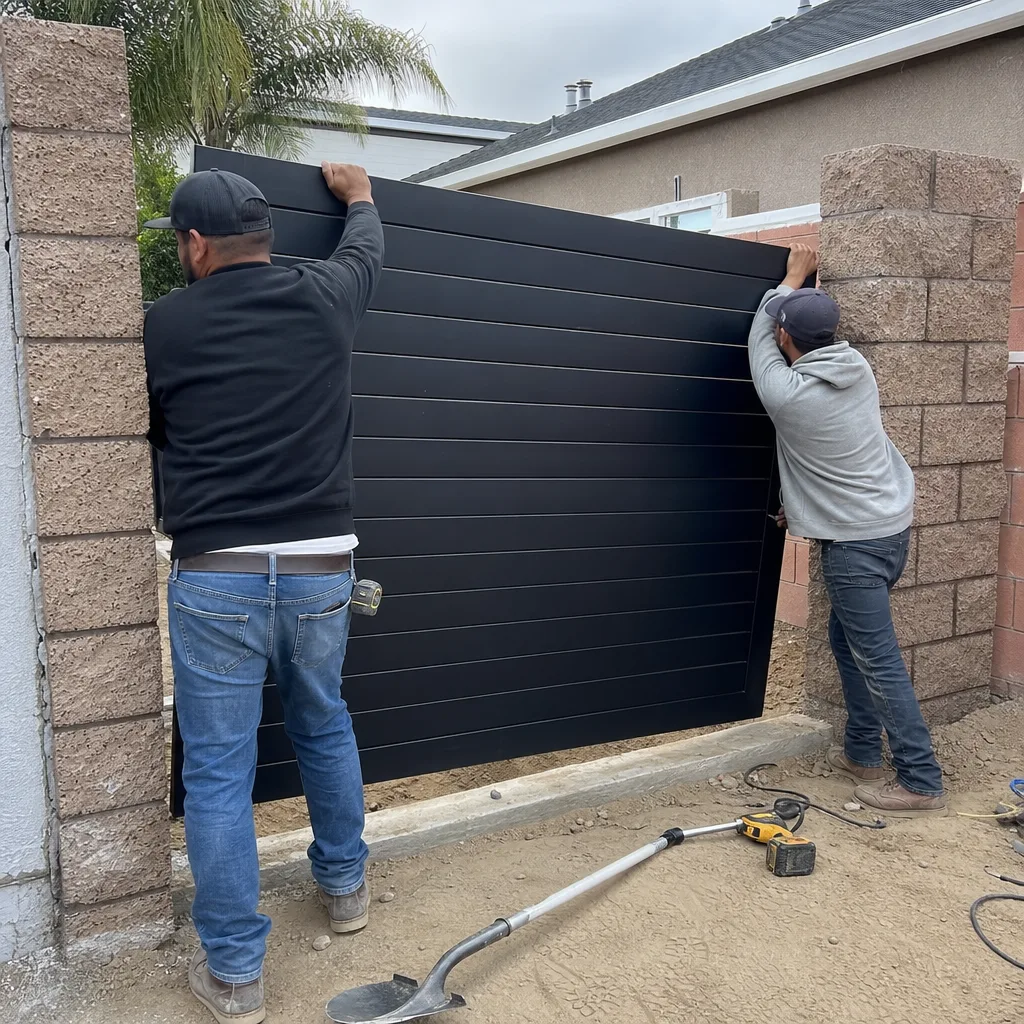
- Replacing the remote battery before checking anything else. A dead battery is the most common explanation, but if the gate still won’t move after a battery swap, stop replacing parts and start asking what else could be wrong. The second-most-common mistake is replacing the remote when the operator’s receiver is actually the failed component.
- Adjusting limit switches without photographing the original position. One un-photographed quarter-turn later, the gate now over-travels in both directions, and the homeowner has no record of where the settings started. The next technician’s diagnostic time is spent reconstructing the original limits, and that time is billed.
- Buying a knockoff remote because it says “compatible with.” “Compatible” on Amazon means it transmits on the same frequency. It does not mean it implements the OEM’s rolling-code protocol correctly. We’ve replaced enough knockoff remotes on Viking, Ghost Controls, and DoorKing operators to know the failure pattern: it works for a month, then stops. The $20 saving becomes a service call.
- Treating the gate as a single machine. The mechanical, electrical, control, and accessory subsystems each fail differently. Repairing the wrong subsystem costs money and delays the actual fix. Learn the four-subsystem model before you buy a single part.
- Running line-voltage electrical work without considering permits. The low-voltage side is DIY-friendly. The 120V side isn’t. In Rancho Cucamonga, unpermitted line-voltage work discovered during a claim or sale is a retroactive permit and a potential denial letter from the insurer.
- Ignoring a non-working safety edge. A safety edge that doesn’t reverse the gate when something blocks its path is a liability, not a maintenance item. If your monthly cardboard-box test fails, disconnect power and call someone who can fix it. This isn’t a task where “I’ll get to it next month” is a responsible position.
When to Call a Professional
Call a professional when the repair touches the control board, the capacitor, the line-voltage side of the transformer, underground loop wire, gate post anchoring, or operator mounting. Call a professional when you’ve already replaced two parts and the problem persists, because the next part you buy won’t fix it either. Call a professional when the gate is binding, straining, or making a sound you haven’t heard before, because that’s a mechanical problem announcing itself, and mechanical problems don’t self-heal.
Call a professional when documentation matters: when the repair requires a wiring diagram to reconnect correctly, when you’re planning to sell the house and want the gate work on record, or when you’re tired of paying twice to rediscover the same problem. Vance Gate Repair Rancho Cucamonga offers free estimates in Rancho Cucamonga. Call (909) 764-3720. A live person answers, any hour, any day.
Frequently Asked Questions
Gate Repair Cost Breakdown: The Rancho Cucamonga Homeowner’s Reference for 2026 shows repair typically ranges from $95 to $450 depending on the component. A remote replacement or photo-eye alignment runs $95 to $180. A limit switch adjustment runs $120 to $220. A control board replacement runs $280 to $600 depending on the brand (Viking, Ghost Controls, DoorKing, Elite all fall in this range). A full operator replacement runs $800 to $1,800 installed. The price you’re quoted is the price you pay under The Haven Standard: written before work starts, no surprise invoice at the end. Call (909) 764-3720 for an exact quote, free of charge.
Yes, most gate repairs can be completed the same day. The exception is structural work: post anchoring, underground loop replacement, or operator mounting that requires concrete work. Those jobs are measured, scheduled, and completed over multiple days because the material cure time can’t be rushed. For everything else, including control board replacement and motor service, same-day repair in Rancho Cucamonga is standard. Call (909) 764-3720 to schedule a repair.
In Rancho Cucamonga, the most common gate repair is photo-eye misalignment and failure, followed by limit switch drift and control board failure. The photo-eye problems are driven by dust and sun exposure during the dry season; the control board failures are driven by power surges during summer thunderstorm season. Photo-eyes are usually a quick fix. Control boards are the repair where you want a wiring diagram and a documented record.
Yes, you can repair your own gate in Rancho Cucamonga. The owner-builder exemption in California covers most residential gate work, including operator replacement and low-voltage wiring. For more guides & resources, see our blog. The line is line-voltage work: running 120V power to a new operator location requires a permit through the City of Rancho Cucamonga. Low-voltage work doesn’t. If you’re unsure which side of the transformer your repair touches, the safe answer is to call a professional rather than guess.
A properly installed gate operator in Rancho Cucamonga lasts 10 to 15 years with regular maintenance. The heat and dust of the Inland Empire climate shorten that lifespan when the operator is mounted incorrectly or when the mechanical subsystem is misaligned, because the motor runs under excessive load. Most early operator failures we see are installation problems, not defective parts.
It depends on the height and location. Most residential driveway gates under 7 feet tall do not require a building permit in Rancho Cucamonga. Gates over 7 feet, or gates within a front setback, may require review through the City of Rancho Cucamonga Building & Safety Department. The electrical feed to the operator is the more common permit trigger. If you’re unsure, contact the city’s Building & Safety desk before you start the project.
The Bottom Line
The DIY versus professional gate repair decision in Rancho Cucamonga comes down to one question: does the repair touch a subsystem with cascading failure risk? If it’s a battery, a lens, a hinge, or a track, you can handle it. If it’s a control board, a capacitor, an underground loop, a post, or an operator mount, the failure mode when things go wrong is delayed, expensive, and invisible until it’s too late. Document what you touch. Know which side of the transformer you’re on. And if you’re ever in doubt, call someone who will write you a price before they touch anything. Call Vance Gate Repair Rancho Cucamonga at (909) 764-3720 for a free estimate.
Written by Adrian Vance, Owner at Vance Gate Repair Rancho Cucamonga home, serving Rancho Cucamonga since 2014.